March 16, 2002-Confessions
You are all very flattering. I appreciate your suggestions to keep on writing the email from an American perspective or try to turn it into a newspaper column. The problem is it would become work if I had deadlines. It amazes me that I never come in after a day of touring & dread writing. I look forward to it. Some suggested I turn the emails into a book, but I’m clueless as to how to go about that. I’ll add several Aussies to my email list when we leave here so they can get the inside story of our further travels.
When I told my manicurist we toured a lobster factory & I had the definitive information on how to cook them, she was very interested. She said that when she boils them live they squeal. Ouch! When I told her they should first be drowned to kill them, there was a long silence. She looked very puzzled & said, “How do you drown something that lives in the water?” When I clarified that these were salt-water lobsters & that you had to drown them in fresh water, she said she had visions of having to hold her hand over their little faces while they were under water. We had a good laugh.
I’ve put off writing about this in hopes that I could cast it in a better light. After much thought about the incident, I’ve determined that there’s just no way to do that. I’m a bigot with what turns out to be strong prejudices. For those of you who don’t know what “hallal” means, it refers to Muslim dietary laws including the ritual slaughter of meat. Muslims slaughter by slitting the animal’s throat the same way kosher meat is killed for Jews. Muslims don’t eat pork, but shellfish is acceptable. When we were in Fremantle, a Turkish restaurant was recommended to us. It was basically a simple kebab place with a more varied menu. As we were seated, I noticed the phrase “hallal” on the sign. I then noticed they had a certificate verifying they were indeed approved for that designation. Since September 11, I’ve become very sensitive. I got very uncomfortable & we left. By all indications, the owners were very observant Muslims & I didn’t want any of my money going to support causes whose tenets might be to do my country or my people harm.
Yesterday, Radio National (similar to our National Public Radio) had a call in show on the subject of the Middle East. Radio National isn’t a show that attracts loonies like the Rush Limbaugh Show does at home. It has presented many progressive thinking & open discussions in the past. This time I was appalled at the anti-American sentiment. Callers said that the events of September 11 were the results of the U.S. policy towards Israel. Then the calls turned viciously anti-Israeli. I don’t wear rose-colored glasses as far as the mess in the Middle East is concerned, but I was shocked & alarmed by the tone of those calls. The callers kept referring to Palestine. Do they live in a time warp?
March 17, 2002-Guilt and Pleasures
To whom it may concern, Happy St. Patrick’s Day.
In the small world category, a member of the congregation has family visiting them from the U.S. The visitors live in Longwood, Florida. That’s the neighboring community to Orlando where I grew up. They know the entire family of one of my best friends from grade school & college roommate.
While buying a somewhat “controlled substance” at the pharmacy yesterday (1% cortisone cream) David was asked for his surname, which he gave. When asked for his Christian name, he said he didn’t have one. There was a moment of awkward silence & then he explained that he had a Hebrew name & a first name. The ding-a-ling at the counter then asked him if he had a name that he used, like in school. Ah, the bliss of ignorance!
We went to see Rabbit-Proof Fence last night. We figured it wouldn’t be easy to find at a theater in the States. It wasn’t even easy to find a show here. It was being shown only once daily & when we got to the theater, it was empty. I was really surprised. I guess Australians are different from Americans. When there’s a film about the horrors we perpetrated in our past, we flock to the movies so we can bathe in guilt & drown in recrimination. Here, they just avoid, ignore, & bury. They figure they’re throwing $A 48,000/aboriginal person/year at the aborigines so, no worries, even if it isn’t working. The film was a bit disappointing. David said it was a twenty-minute story that took 1-½ hours to tell. The film takes place in 1931, but the policy was in place until 1970. We were never bored & there were a few surprises. The first thing I learned was that the “stolen generation” referred to the half-caste children (white & aborigine) who were forcibly removed from their homes so they could be raised in white society. I originally thought they removed full aborigine children as well. Another surprise was that the people who organized & perpetrated this injustice were all well meaning. This was not done to inflict harm or cause pain. The Australians sincerely believed the half-castes could be classified as black or white. They decided to classify them as white & to give them every advantage of white society by removing them from everything aborigine. The goal was to “breed the black out of them” in three generations. The scariest realization for me was that they committed this atrocity out of the goodness of their hearts. At the end of the film, before the credits rolled, there was a narrative to bring the viewer up to date. This was a shocker. Molly, the fourteen year old who led her sister & cousin on their 1200-mile odyssey of an escape from the orphanage, later married & had two children. She was re-captured with her two children & escaped with them. Her three-year old was later re-captured & Molly never saw her again.
Toby
Thursday, August 19, 2010

Killing Time


March 14, 2002-Styling City
(photos:Police & aborigines,
London Court,
Cheeky pelican & me)
We woke up an hour before we were supposed to this morning. The clock/radio had the wrong time & we didn’t notice it when we set it. We managed to occupy ourselves until it was time to check out. We had the day ahead of us & our flight didn’t leave until 11:15 PM.
Although we’d driven through Perth & had seen it from afar, this was our first opportunity to walk the streets & really feel the city. We found it to be surprisingly stylish with attractive modern buildings well blended with the old historic ones. A lot of restoration & preservation was going on & it seemed that the planners were doing it thoughtfully.
We ate brunch at a café on one of many pedestrian malls & watched the city wake up. It was alive with buskers, spruikers, & push cart vendors. There were more aboriginals than I expected to see & they were promenading the streets & socializing. There was a lot of interaction between them & the police, but it didn’t seem adversarial. The first thing I noticed was the abundance of police. The second thing I noticed was that the police wore shorts & had great legs. In the evening, the police presence is augmented by an aboriginal volunteer patrol that, as the police told us, handles “their own people.” The volunteers had no power to detain or arrest & had to call any problems in to a central police switchboard. The officers said that by the time the cop on the street heard about a problem it was resolved or had gotten out of hand.
We followed the walking tour in Fodor’s Guide Book & took advantage of the shops along the way. We did some serious souvenir shopping in stores that had far superior crap than I’d seen elsewhere in Australia. Our trek took us to an alley called London Court. It could have come out of a Harry Potter book. It was designed along the English half-timber style & the narrow lane gave the buildings the appearance of leaning in towards each other. St. John’s Pro-Cathedral, our next stop, had an unusual feature. There was a blue 5-gallon tank of holy water by the door. If you brought your own bottle, you were welcome to fill it from the tank. By the way, does anyone know what a pro-cathedral is? St. George’s Anglican Cathedral, built in the 1850’s, was a surprise. It was the first cathedral I’d seen that had brick interior arches. The ceiling was constructed of jarra wood that soaked in the river for two years until it was pliable enough to bend into beams. The cathedral was originally designed to be built of stone, but it was not possible to quarry the stones due to a convict shortage. They ended up making the bricks on site & using them instead.
When we found our walking tour was taking us past the new fire station, we realized there was nothing more worth seeing in Perth. We still had about nine hours to spend in the 90-degree heat until our flight. We headed south to Mandarah. It’s a small hamlet huddled around Peel Bay. Fortunately for us, it has some of the best homemade ice cream. We strolled along the water & were entertained by dolphin playing in the shallows. We found the pelicans as pushy as the seagulls & enjoyed their antics as they joined together to beg for handouts. Dogs & humans joined the menagerie in the water to make an entertaining sight.
I guess they don’t have the problem there that we have on the Gold Coast. We just read that there’s a shark feeding frenzy going on two blocks from our apartment. Beaches have been closed as hundreds of sharks gathered around an enormous school of fish. They divide up into groups of fifty or so & herd the fish into smaller more manageable groups so they can feed more easily. Word has it that whales have joined the fray. If I have enough energy when we return, I’ll walk down to the beach to see what it’s about. Tuesday begins the big week for the surf lifesavers competition. I wonder if they’ll cancel it or add a shark-roping event.
We went back to Northbridge in Perth for dinner at Harriet’s Restaurant. It was highly recommended, but we weren’t too optimistic. You know the drill about expectations. Were we surprised! The food was so good that we kept asking our server about it. We found out one interesting combination that made a great foccacio dip was sour cream & sweet chili. The man at the table next to us was alone & we struck up a conversation. He was from British Columbia in Canada & was a geological engineer. He was in Perth to meet with clients who were building a gold mine in Laos. Who would have thought that Laos had gold? Somehow, “Maybe I can interest you in a gold mine in Laos,” doesn’t have a ring of authenticity.
March 15, 2002
I love hearing from you all. Someone who gets these email, made an interesting observation after reading about our harrowing day of problems culminating with the night drive through kangaroo territory. Come to think of it, that would be the entire continent. She referred to it as a “pathetic litany.”
I am finishing the email from our apartment. The flight went off without a hitch except for the ungodly hour. We did get to see sunrise over the outback. It looked like the sky was bathed in a rainbow. Starting from the horizon, the black rugged land was silhouetted against shades of orange, yellow, blue, & purple.
Toby
Sunday, August 15, 2010
Lobster Fest


March 13, 2002-Do No Harm
(photos:Female on left male on right,
Perth,
Melbourne Hotel)
David is going through his evening ritual. Each night that we stay in a new hotel he fiddles with the air conditioner to see if he can re-direct the airflow away from my side of the bed. So far he has failed, but I love that he tries. Tonight we’re back in Perth & staying at the Melbourne Hotel. It’s a boutique hotel with only thirty-two rooms & is housed in a completely restored 1890’s building. I’ve mentioned that wrought ironwork is popular on buildings in Australia. They fashioned the steel from old ships into elaborate balconies & trim. Our room opens onto that very balcony. This particular hotel has chosen a Louisiana theme to match the old exterior.
Our day started in Geraldton at the Brolos Live Lobster Factory Tour. As we approached the building, David reassured the lobsters that we meant them no harm. For those of you who don’t know, our version of keeping somewhat kosher is that we don’t eat pork or shellfish. We did find the tour fascinating. This factory only handled rock lobsters that were to be shipped live. The rejects were put in fresh water to drown & sent to a processing plant to be cooked & prepared to ship out as processed lobster. Only 30% of the lobsters qualify to be shipped live. Of the live ones, 87% go to Asian markets. Because of over-harvesting their waters, Asia has depleted its resources & has to import. Even though a female will produce from 100,000 to a million eggs, most don’t survive. It takes six years for a lobster to mature & the Asians weren’t patient enough. There was one tank with twenty-year-old six-pound lobsters destined for China at $200 a pop. The average lobster runs about $60/lb with the wholesale price at $17.50/lb. Rock lobsters are a $300 million business in Western Australia. This particular plant did $50 million/year. All figures are in U.S dollars.
The lobsters (also called crayfish) arrive fresh off the boat. The dock is right next to the factory conveyor belt. They’re sorted by size, quality, & color. They’re only permitted to have three legs missing (not all on one side) & cannot have cracked shells, eggs, or be pregnant. They then go into holding tanks for three days of R & R to recover from the ordeal of being trapped & transported. Because ocean water off the coast of West Australia is so unpolluted, it’s used in its natural unfiltered state to keep the lobsters fresh. It’s pumped into the tanks directly from the sea & pumped back into the ocean from those tanks. Tanks are monitored for any lobsters that later die (they’re cannibalistic) or become weak or damaged since they change the oxygen level in the water. Fisheries inspectors come at will to supervise the fishermen & factory.
To prepare them for shipping live, the lobsters are given a three-minute bath in the frigid water of the stun tank. This puts them into a state of hibernation. They’re then packed in a Styrofoam cooler, covered with pine shavings & ice, & shipped to their destinations within thirty hours. It takes Federal Express three days to get a parcel from Eastern Australia to Ohio. When delivered, they’re given a warm water bath to wake them up. There’s a 99% survival rate.
Lobster fisherman work from November to June 30. That’s when it’s not breeding season. They have a major investment in their boats. Fully equipped with radar, lobster pots, seawater hydration systems, etc. the boats could sell for up to $3.25 million. They move out to live on islands off the coast & take their families with them. There are grammar schools on the islands, but when their children reach high school age, fishing families have to decide whether or not to trade their licenses in for offshore rather than deep sea ones. At that point they might move into town.
We got an object lesson in telling the difference between males & females. It’s obvious once pointed out. The female has claws under her tail & the male has two penises. Need I say more?
As a non-cooker of lobster, I’d like to give you all a cooking tip. The definitive word is that lobster should NEVER be cooked live. Aside from being extremely cruel, they convulse, lose their legs, & are tougher. The correct way to prepare them is to drown them first. If put in fresh water, they cannot survive. I guess it’s the lesser of two evils, but given that they’re not going to come out of our food chain alive in any case, drowning is preferable.
More Gems
A by-product of the tour was that I picked up an invaluable list of how to treat whatever sting or bite we might get whilst visiting Australia. The list includes jellyfish, stonefish, snakes, & insects. By the way, lobsters carry bacteria that can make you very ill. It’s carried on their shells. We left the factory with our heads reeling with lobster lingo & lore & went for a look at the “hidden gem” of Geraldton, Marine Drive. Much to our surprise, it was across the road from the industrial park. The Indian Ocean was obscured from view by dunes. I think it would have made a better marine stroll than a drive. We happily left that burg behind us & started to go south towards Perth.
We came across the Greenough Historic Hamlet. It’s a preserved village founded in the 1860’s. Some buildings were built by ticket of leave convicts (parolees). The schoolhouse was used until 1951 & churches are still in use. It was interesting to note that, although very old by West Australian standards, it parallels our Civil War. At first I was surprised to see photos of the early settlers, but then remembered Matthew Brady.
We weren’t pleased to note that the timing of our travel meant we’d be back in Dongara, that sleepy town, for lunch. It ‘s amazing how little it takes to make us happy now. Perhaps it’s because we’ve lowered our expectations to meet the reality around us. We were curious about the Priory Lodge, a convent turned hotel & restaurant. It’s a work in process & needs a lot more processing before it will work. We ordered sandwiches & got typical fare. They were served on overdone toast, spread with mayo, salted, & somehow Cajun in Australia means tasteless
Our ride continued past miles & miles of burned out land where blackened landscape on one side of the road contrasted sharply with the lushness of the other. We eventually emerged in Perth to be greeted with such an American phenomenon that it totally startled us. We were stopped at a red light when a young man emerged from out of the blue & started washing our windshield. Although this has never happened to us in the States, here we were in Australia having an authentic American experience. He didn’t look sinister nor did he ask for money, but we did pay him.
We settled into our hotel & started to think about dinner. It seems I just finished telling you about lunch. Fodor’s Guide Book recommended Uncle Billy’s in Chinatown. It was within walking distance, so we stashed the car & hoofed it. Along the way we found a happening area called Northbridge, which is where we’ll probably eat tomorrow. Billy’s food turned out to be mediocre at best. Watermelon was the tastiest part of the meal & we had to eat it Southern style, with salt. Ours was the only table that had no Asians. There was a large round table with about eight diners. The Chinese people there spoke to each other in Chinese & to the Caucasians in Australian accented English. I realized it was a business dinner when all eight of them rose at once, leaned across the table, & exchanged business cards carefully offering & accepting the cards using two hands. Our authentic Chinese meal ended when David asked for the bill. The Chinese server said, “No worries.”
David is watching TV & waiting for me to finish this. We tried to watch last night, but the only reception we got was a BBC program that was so anti-American & pro-Arab we had to turn it off. It tried to validate & offer rationales for the 9/11 attacks. It was shocking to see something of that nature at this time. Being in a Commonwealth country we occasionally do get to see the true colors of Britain. Despite Tony Blair’s support now, they were usually not on the same page as we when it came to the Middle East.
David usually reads the books on services provided by the hotels. He learned that once a week they check the fire alarm system here. That would be tomorrow morning. Hopefully, it will be done after the 10 AM check out time.
Toby
Saturday, August 14, 2010
Landscapes


March 12, 2002-Wild & Wacky
(photos:Road to nowhere,
Nambung National Park,
Stromatolite colonies & red algae)
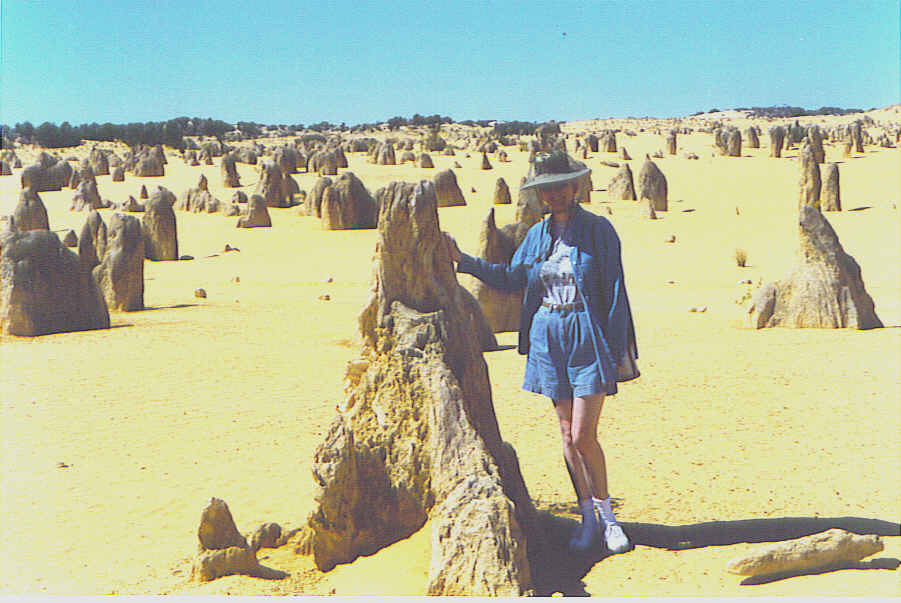
To borrow a ditty, “ The flowers that bloom in the spring, tra-la.” That should have told us something. It’s autumn here now & the wildflowers, they do not bloom in the fall. We saw two clumps of black-eyed Susans & some acacia trees with leftover yellow flowers. But Nambung National Park did not disappoint. It’s where red & yellow sands of desert meet bone white dunes. It’s where yellow desert meets tourmaline green & delft blue sea. It’s where the sea melds into a sky that’s so sky blue there’s no doubt why the color was so named.
We pulled our fly nets over our hats & trudged into the 95+-degree heat. We’d come to see the approximately four square mile area known as The Pinnacles Desert. The pinnacles are limestone formations that were left when tiny shells & plants were compacted into rock & then eroded away by wind & water into sand. The sand further wore away at the limestone until what we see today is a forest of pillars. Mostly tan with some red & pink accents, they reach up to fifteen feet tall. Thousands of them dot the landscape in what some say resemble enormous termite mounds. Others call it a moonscape, but I prefer to think of it looking as if a giant pre-historic bird picked & pecked on the pillars until the desired pock marked effect was achieved. It could also be described as if the randomly scattered protuberances were strewn around the area by an alien race that hurriedly established a cemetery. It was Stonehenge run amok.
Part of our adventure was the approach to the desert park. Of the eight-mile road, the last two and a half miles were unpaved washboard. The result was that our partially consumed bottles of day old Diet Coke achieved a new level of effervescence as they performed a St. Vitas-like dance & jiggled in their holders as if demon possessed. The National Park welcomed us with a typical Aussie sign with dire warnings of imminent death. Evidently there are poison baited fox traps in the park that are also lethal to pets & humans. There was at least one heedless roo kill by the side of the road. It was hard to tell if it had been poisoned or lost a battle with a vehicle. I wanted a picture of it since it was mostly intact, but David got a bit squeamish.
By now, we were on our way to Lake Thetis & tackling yet another unpaved road. We reckoned we’d broken three out of four of the rules of car rentals in Western Australia. We’d driven in remote areas at night, told them we would use the car South of Perth & were now majorly in the North, & we were on unsealed roads. The fourth cardinal sin was to attach anything to the roof. We were ok on that one so far, but then there was that attractively tempting kangaroo carcass.
Stromatolites brought us to Lake Thetis. We had read about them in Bill Brysons In a Sunburned Country & answered their siren song. Fortunately, we didn’t end up car wrecked in the sand, but these miniscule life forms were worth the diversion. Thought to be extinct, they’re among the first life forms on earth & are the only living stromatolites known in the world. These microbial communities are about 1200 years old. Fossils exist elsewhere that are 2-3,000 million years old & date from the pre-Cambrian era. The live in grayish brown mud like colonies around the lake where there’s also a fascinating growth of a beet colored algae. Unfortunately, some tourists have no concept of the rarity of this recent find & have left the international calling card of cigarette butts.
Our drive took us on to the northern leg of the almost completed coastal highway that will soon link Perth to Darwin. It’s hard to believe that in this day & time they’re still so remote. As we entered the Shire of Carnamah, a sign warned “ No New squatter development would be permitted after 18 March 1992.” Several old squatter shacks were obvious. I was glad to see that in this modern & self-proclaimed sophisticated country there was still room for third world concessions. We entered the Batavia Coast region named for a Dutch East Indies Co. ship that foundered on its shores. I wonder how that company managed to stay in business let alone maintain its Dutch West Indies branch with all the ships it lost in the seas around Australia. Dongara was our stopping point for an ice-cream break where the Aussies, famous for tasteless food, outdid themselves in the manufacture of tasteless ice cream. The main street of the town was lined with huge, ancient, looming Moreton Bay Fig trees. David said that it re-defined the term “sleepy town.” I think that Mexico should send a contingent to study with the masters of the undeclared siesta.
As we headed for Geraldton, we were treated to the sight of sheep marching in a line across a field. There was no dog or human in sight. We wondered what compelled them to trek so purposefully. Our answer came when we spotted a lone straggler with a dog hot on its heels. It occurred to me that these sheep dogs are the animal definition incarnate of OCD (Obsessive Compulsive Disorder). They doggedly (pardon the pun) pursue their charges & don’t rest until every last one is herded, collected, rounded up, sorted, & relocated or penned. As an admirer of animal intelligence & a control freak, I have a new model to hold up as an ideal.
Toby
Thursday, August 12, 2010
Losing It


March 11, 2002-Lock Up
(photos:Gallows,
Prison art)
How can a day that started out so well unravel, dissolve, & then come together in a tidy package as if it was planned that way? Maybe it was. We woke up to a gloriously sunny 75-degree day in Fremantle. We stayed at the Esplanade Hotel situated across from a park of the same name & overlooking the harbor. It was a premier palace of a grand old hotel & nearly encompassed a city block. Its porches embraced its bulk giving it an aura of being lighter than air. We found a funky bakery, had a luscious breakfast with to-die-for million-grain bread, & hit the streets to tour.
We really liked Fremantle. The reason it has such a youthful presence is that Notre Dame University is there. We shopped, took lots of photos of the colorfully painted, dramatic, & gloriously restored Victoriana, & headed for jail. The Fremantle Prison is a brooding granite & sandstone hulk built by, you guessed it, early convicts. The 10,000 transportees from Britain started construction in 1840 & the first prisoners moved in ten years later. Over the years, more serious prisoners from the local population replaced the early convicts. Some of the cells have amazing artwork done by them. We were given the option of seeing the gallows & took it. They explained how the condemned was weighed & measured to insure the rope did its job. They were left hanging for thirty minutes before the doctor certified them. One of the more famous escapees was an Irishman named O’Reilly. He & six others were political prisoners. He ended up in Boston & established the Boston Globe. His family still runs it today. He funded the escape of the six others all of whom went to the U.S. & made their fortunes legally. There was a massive riot in 1988, but the place didn’t shut its doors until 1991.
Nightmare Begins
Our first clue that things were coming apart was when we got to see Perth from the North, South, & East. Blessedly, we missed the view form the West. We were trying to get to the Swan Valley wine region & couldn’t find the right highway. I was working from three maps. The roads were either indicated by name or highway number, but there was no way to match the names or the numbers with any of the signage. We knew we had to head for the airport, but there were no signs in the vicinity of downtown Perth to indicate where that might be. When we finally blundered our way to Swan Valley, the first winery we wanted to go to was closed. The second one had less than satisfying products, & we gave up on the third. We decided to head for the tranquility of the monastery at New Norcia. We would either stay at the mission or in the hotel both of which were run by the Benedictine monks. The monastery, the only one in Australia, boasted a marvelous art collection & a first class museum.
Our route took us down roads lined with termite mounds & ghostlike white gum trees with their shaggy bark strewn on the ground like the feathers of molting birds. Kelly green parrots with yellow ringed necks were vying with gray & pink galahs for the last scraps of the day. The pastoral ambiance was enhanced when a man on a dune buggy herded a flock of sheep across the road. The sheep dog was placidly watching the activity from his perch next to the buggy driver.
Things began to unwind when there was no room to be had in New Norcia. I recall that there was another Jewish family who was turned away at the inn & I’m sure we will not be the last. I’m also sure we will not make the kind of history the other family did. Our innkeeper was less helpful than the one of old. Ours didn’t even offer us a stable. He just callously sent us thirty-five miles down the road to Moora.
Moora is a town waiting to die. It may even be dead, but hasn’t gotten the message yet. The skuzzy motel was fully booked. The hotel had a room, but the bath was down the hall. In desperation, I went to look at the room. Through the partially opened door I glimpsed layers of paint peeling off the walls, a poorly made-up bed with graying sheets, & a stained spread. A mangy man was about to enter the only common bathroom on the floor when I handed the key to the clerk & left. I’d decided I would rather sleep in the car.
My Knight
Distraught is a good word to use here. On the verge of tears is another. I was paralyzed. That’s when my knight in shining armor sprang into action. David called a motel in the town we wanted to be in the next night & booked a room. At this point I was grateful that Ron & Karen left their granola bars with us when they could’t take them into New Zealand. They were a lifesaver.
It was 7 PM, the sun was down, & we had a two-hour drive through the outback. We were about to risk life, limb, & car. We were also about to go contrary to the extremely strong advice given by the car rental company. We were entering kangaroo country at night. David was so tense that his hands cramped as he gripped the steering wheel. His eyes dried out because he was afraid to take them off the road long enough to blink. We imagined that large flying bugs were leaping roos as they flashed in our peripheral vision & hit our windshield with a repulsive pit-a-pat. Shadows, fallen limbs, & shrubs became sinister road hazards in the dark. The two-three trailer long road train trucks seemed to dominate the narrow roadway as they thundered past confidently knowing that any kangaroos they met would be no match.
And then we saw them. There were two of them. They always seem to come in pairs. They must have been the largest roos we’d seen anywhere. David thought they were twenty feet tall, but I figure they were only a bit over five feet. They were standing in the middle of the road oblivious to the headlights bearing down on them. They were facing each other as if trying to decide where to go for dinner or perhaps they were old friends just catching up on gossip. It’s a really good thing that kangaroos have white bellies & are easily visible in the dark. It was a far better thing that David had his high beams on & has good reflexes. He didn’t jam on the brakes, but he did vigorously apply them. The roos took the hint without a beep of our horn. They ambled off the road at their clumsy slow gait looking like a pair of wounded warriors using their tails as crutches.
An hour & a half later we emerged into civilization. There was a filling station ahead. During the entire drive we were mindful that even as our gas gauge was falling, the one station that we passed was closed. We re-fueled & continued onto the dark desolate night highway. There was light at the end of our nightmare tunnel & a pot of gold at the end of our bleak rainbow. There were no windmills to welcome us & no half-crazed knight to do our bidding, but we’d arrived in Cervantes. The sign of our motel was a literal beacon as was the sound of glasses clinking at the patio bar. David said he was going to fall apart when we got into the room. He didn’t live up to that promise. He went to the closed restaurant of the motel to negotiate ice-cream bars, a cookie, & nuts. Bon apetite.
Although we really wanted to wing it for this trip, we booked a room for tomorrow night. It seems that the tourists re out in force. It’s not school holiday time, but it is wildflower season. The hills are supposedly alive with their riotous colors & hordes of rambling tourists.
Toby
Wednesday, August 11, 2010
On The Move Again


March 9, 2002-Departure
(photos:Our motto,
Quokka & me)
We’ll be on our way to Perth this evening. Perth is in the state of Western Australia. W.A., as it’s called, takes up 1/3 of all the area of the Australian continent. We leave at 8 PM & arrive in Perth at about 10:30PM. There’s a time difference, but I’m not sure what it is. I’ve heard that the flight takes anywhere from 4-7 hours.
This is a tidbit from the paper this morning. Australia has the highest youth suicide rate in the world. There’s a high rate among aborigine youth, but that doesn’t account for the extraordinarily high rates in the cities among the youth of European extraction. No reasons were given. So much for the happy go lucky Aussie image. Maybe a combination of the macho culture & the cultural endorsement of bouts of heavy drinking are clues. Perhaps the less blond & non-blue-eyed feel inferior. What if a young surf-worshipping Aussie just doesn’t look the knockout in a bikini?
March 10, 2002-Arrival
The flight from Brisbane to Perth is 5 ½ hours. It’s the same as flying from New York to Los Angeles. There was a scene at the departure gate that was reminiscent of when we left home. A young woman was being seen off by what I assume was an extended family including several young children. They hugged, kissed, & clung to each other until the last minute. They reluctantly tore away from their embraces as the sobbing woman made her way to the plane. David & I turned to each other & cried along with them. I’ll never forget that wrenching feeling of helplessness & acquiescence of the inevitable. Although we’ve had a once in a lifetime experience, it will remain just that. We will not be gone for nine months again.
Although the flight was uneventful, as it should have been, David did notice a serious breach in security that he’ll report to Qantas as soon as he has a chance to email them. During the flight, one of the flight attendants opened the cockpit door, stood there for some time, & chatted with the crew. Scary.
We saw a promotional video about the making of the movie The Rabbit Proof Fence. I don’t know if it’s big in the U.S., but it’s huge here. It’s about the time in Australia’s history when white Australians forcibly took aboriginal children away from their parents in a misguided attempt to integrate them into white society. The children are called the stolen generation. This is a story about how three young girls escaped their white homes & made their way back to their clans. They did this by following a fence that stretched across the desert to keep the plague of European introduced rabbits away from the outback stations (ranches). The video followed the director while he auditioned, selected, & worked with three amateur aboriginal actors. The scene where they’re literally torn from the arms of their mother I found to be emotionally wrenching. When they showed the reaction of the cast, crew, & director after the shoot, I also dissolved into tears. The young stars were inconsolable. This part of their history became so real for them that they had to be held, rocked, & comforted until they could recover their composure & go on.
We arrived in Perth on time & our car was ready & waiting for us. The only caution we got from the rental agent was that the insurance didn’t cover the car if we drove it between towns at night due to the high number of car/kangaroo encounters of which there were no victors. Locals don’t drive in remote areas at night. That reminds me that in our 5-½ hours of flying across the 3,000 miles of Australia we saw no lights on the ground. That’s 3,000 miles of absolute darkness. It was as if we were flying over the sea, but this one was of rock & sand.
We stayed at Miss Maudes Swedish Hotel. We booked it online at www.wotif.com.au. It’s a boutique hotel built in 1911. It has a European atmosphere & a great buffet breakfast. We didn’t tour Perth today, but headed for Fremantle & Rottnest Island. Fremantle is now a trendy tourist destination & a suburb 12 miles south of Perth. The British settled it in 1829 when it was just a salt marsh. They quickly moved to Perth, but Fremantle remained the main port of Western Australia & was a U.S. submarine base in WWII. It’s a town full of the vitality of the many young people who crowd the streets set against the background of its well-preserved Victorian buildings.
We had our first glimpse of the Indian Ocean from the ferry to Rottnest Island. It’s actually the remnant coastline & thousands of years ago totally submerged. The island was first found in the early 1600’s when ships from the Dutch East India Company foundered on its reefs. It has come a long way from being the bane of the shipping fleets to the eco-reserve it is today. Tourism is limited, development has ended, & no commercial fishing is permitted within 800 meters of the shore. With hugely fierce winds from the southeast, it is rated as the 3rd windiest place on earth after Chicago & Wellington, New Zealand. It’s a haven for scuba & snorkeling & boasts a marked snorkeling trail with plaques imbedded in the sand to narrate the underwater sights. There’s nothing between its westernmost shore & Mauritius off the coast of S. Africa.
Along with referring to Fremantle as Freo & Rottnest as Rotto, our guide on the two-hour bus tour told us there were no “bities” in the water. He meant jellyfish, not sharks. He said there has never been a death caused by a shark, but that several people a year die in bicycle accidents. Cars are severely limited on the island, but folks seem to find ways to kill themselves in falls anyway.
There’s an old WWII gun emplacement, a lighthouse, & supremely private bays & coves, but those features pale in comparison to the main draw of the place. It’s the home of the quokka. It’s the only place on earth where this cat sized rat-tailed wallaby like marsupial is found. They were marooned on the island when it was separated from the mainland & all of its predators were left behind. Since no pets are allowed on Rottnest, quokkas enjoy complete security. One of their favorite foods is the Moreton Bay fig. They eat them after they’ve fallen to the ground & ferment. Then these little brown fuzzy creatures lie on their backs & make a god-awful sound. They’re the namesakes of the island. Rottnest means rat nest in Dutch. They’re fearless. I had one drinking water out of my hand.
No Australian story would be complete without the prison angle. In this case, Rottnest was used to house aborigine prisoners. I asked the guide if they were criminals. He said that most were in for minor offenses, but they were used as cheap labor. The party line was that they were incarcerated “for their own good” & to bring them into the white culture. They were free to roam the island at will, so why did so many try to escape?
Toby
Monday, August 9, 2010
Soul Searching
March 8, 2002-Clarification
I’ve been a bit introspective the last few days & would like to share my thoughts privately with the sixty-nine people who get this email & with all of their friends & family to whom it is forwarded.
I think I’ve clarified & synthesized some of my thoughts & feelings about our stay. There are two aspects of our time in Australia that bear examination. For the first, I need to share with you an experience I had when I was nine-years old. Pay attention all you shrinks. My father had sold his business in New York & we moved to Miami Beach, Florida. I went from the only neighborhood I’d ever known, lifelong friends, & a close extended family to an alien place. I quickly learned that it was pointless to make friends at school since the children were primarily there for the “season” & the friendships would not be lasting. We eventually moved to Orlando & a more stable environment. I’ve had a hard time moving ever since.
I have envied people who have stayed in a community & who have deep roots & family ties to that community. It amazes me that some of my friends are still friends with people they knew in kindergarten. And so, I approached this experience a bit like my nine-year old self. I saw it as a wrenching away from people & places that were familiar & loved. When we arrived, we really did toy with the idea of staying on. Even though it was appealing, it did make me a bit anxious. I had a sense of displacement here. Actually, it was more a feeling that I’d been misplaced. I was “other.” I didn’t try too hard to learn how to recognize the money since VISA seemed to work just fine. Now I can recognize that the pasta colored scraps that emerge from the ATM are $A 50 notes. I was hesitant to speak to sales clerks in stores or, at least, self-conscious because there were always misunderstandings due to language differences. This became even more discomfiting after 9/11 when my American accent seemed to stand out like a beacon. Even today, I just noticed that a “goods lift” was a service elevator. When I took the $A 890 check from the medical insurance company (yes, we’ve already been reimbursed) to the bank, I told the teller I wanted to deposit $A 790, & take $A 100, in cash. She looked at the check & said that it was non-negotiable. I couldn’t understand what the problem was. The insurance company account was with the same bank & the check was made out to me. To me “non-negotiable” is just that. I’s funny money. It’s not cashable. It’s not legal tender. The teller went on as if nothing was really a problem as she told me I could deposit the check in its entirety & then withdraw $A 100, from my account since we had more that enough to cover the $A 100 without the $A 890. So, I learned that in Australian banking lingo non-negotiable means “depositable” but not “cashable.”
Now I would like to address the second aspect of this dilemma. Last night David said he was so ready to leave. When we discussed it further, he said that, if asked, he would say he liked Australia, but not the people. That’s absolutely counter to every stereotype about this country we’d absorbed. We had pictured Aussies as open, friendly, warm, & fun loving. Except for the Bruces, the people at temple were far from that. Then we realized that most people at temple weren’t Australians, they were Brits. The Bruces however, are native Aussies. For the most part, the people in the congregation are hospitable, welcoming, & polite, but more distant & taciturn. I feel more at ease with the dry cleaner or my manicurist than I do with them. We feel a warmth radiating from the lady at the kebab stand that we don’t get from the people at temple. I knew she was Kurdish, but I never knew what religion she was. I asked if we could take her picture & she declined. I asked her if it was a religious issue. She said it was more cultural & that she’s a Zoroastrian. What it boils down to is that we really do like Australia & Australians. It’s the Brits that aren’t any fun.
We ran into a very considerate agent at Cathay Pacific when we had the dates on our tickets to India changed. She rang us the next day & left a message that due to the nature of our tickets, we weren’t eligible for frequent flyer miles on American Airlines. She rang back the day after & left another message asking us if we wanted kosher meals on the flight. I couldn’t figure out how she knew we were Jewish. People here aren’t that aware of ethnic clues to Judaism, like last names. We even had a passport control worker who didn’t know what a rabbi was. David finally remembered that on our out-going message at the apartment it says,” You have reached Rabbi David & Toby Horowitz.” I guess this worker knew what a rabbi was. I thought that it was very considerate of her to make the inquiry.
Finding kosher for Passover food here is another story. Passover is the holiday when we don’t eat leavened foods ( e.g. bread) to remember when the Children of Israel led by Moses, escaped Egyptian slavery & wandered in the desert for forty years. We ordered matzo through the Temple, but when the Bruces invited us for the first Seder (ritual meal to commemorate the escape to freedom & desert experience), I offered to make dessert. Not having any of my recipes here, I thought I would rely on a commercial boxed brownie mix. There are no, zero, zip displays of Passover foods at any of the grocery stores. They don’t even have the stuff hidden on the shelves of “gourmet” foods where they keep the taco sauce. We had to go to a gourmet store that carries a few boxes of matzo for Pesach ( Passover) & have them order the mix for us. They will let us know if they can get it.
When Karen & Ron were here they bought a box of Tim Tam biscuits (cookies) for an English friend of theirs. He raved about them & that’s all he wanted from Australia. A Tim Tam is two chocolate cookies covered with a layer of chocolate. I’m not overly fond of them, but perhaps that’s because I didn’t know the true secret of the Tim Tam. I learned that it’s best eaten by first ritualistically nibbling off each end. That leaves the majority of the cookie, which is to be then used to suck up coffee as through a straw. It’s akin to the Oreo cookie separate & lick principle.
Some of you have accused me of being “nose obsessed.” How can you say that when it has always been my most prominent, if not my most flattering, feature? I’m happy to report some noticeable improvement. The stitches came out on Monday & I’ve been out on the streets with it in its uncovered (not in the biblical sense) natural state, & no children have pointed or gawked. I do think that because most people are shorter than I am, many have not even seen the area concerned. I should have had David take a photo of me with the bandage on it. I’ve always remarked that we see more people in overseas venues who walk around with sloppy gauze wound coverings or crutches than we see at home. I had joined their ranks. My favorite memory along these lines is from the isle of Rhodes. A man was walking down the street pushing an IV stand with the bottle swinging & jiggling & the IV line firmly planted in his arm.
Toby
I’ve been a bit introspective the last few days & would like to share my thoughts privately with the sixty-nine people who get this email & with all of their friends & family to whom it is forwarded.
I think I’ve clarified & synthesized some of my thoughts & feelings about our stay. There are two aspects of our time in Australia that bear examination. For the first, I need to share with you an experience I had when I was nine-years old. Pay attention all you shrinks. My father had sold his business in New York & we moved to Miami Beach, Florida. I went from the only neighborhood I’d ever known, lifelong friends, & a close extended family to an alien place. I quickly learned that it was pointless to make friends at school since the children were primarily there for the “season” & the friendships would not be lasting. We eventually moved to Orlando & a more stable environment. I’ve had a hard time moving ever since.
I have envied people who have stayed in a community & who have deep roots & family ties to that community. It amazes me that some of my friends are still friends with people they knew in kindergarten. And so, I approached this experience a bit like my nine-year old self. I saw it as a wrenching away from people & places that were familiar & loved. When we arrived, we really did toy with the idea of staying on. Even though it was appealing, it did make me a bit anxious. I had a sense of displacement here. Actually, it was more a feeling that I’d been misplaced. I was “other.” I didn’t try too hard to learn how to recognize the money since VISA seemed to work just fine. Now I can recognize that the pasta colored scraps that emerge from the ATM are $A 50 notes. I was hesitant to speak to sales clerks in stores or, at least, self-conscious because there were always misunderstandings due to language differences. This became even more discomfiting after 9/11 when my American accent seemed to stand out like a beacon. Even today, I just noticed that a “goods lift” was a service elevator. When I took the $A 890 check from the medical insurance company (yes, we’ve already been reimbursed) to the bank, I told the teller I wanted to deposit $A 790, & take $A 100, in cash. She looked at the check & said that it was non-negotiable. I couldn’t understand what the problem was. The insurance company account was with the same bank & the check was made out to me. To me “non-negotiable” is just that. I’s funny money. It’s not cashable. It’s not legal tender. The teller went on as if nothing was really a problem as she told me I could deposit the check in its entirety & then withdraw $A 100, from my account since we had more that enough to cover the $A 100 without the $A 890. So, I learned that in Australian banking lingo non-negotiable means “depositable” but not “cashable.”
Now I would like to address the second aspect of this dilemma. Last night David said he was so ready to leave. When we discussed it further, he said that, if asked, he would say he liked Australia, but not the people. That’s absolutely counter to every stereotype about this country we’d absorbed. We had pictured Aussies as open, friendly, warm, & fun loving. Except for the Bruces, the people at temple were far from that. Then we realized that most people at temple weren’t Australians, they were Brits. The Bruces however, are native Aussies. For the most part, the people in the congregation are hospitable, welcoming, & polite, but more distant & taciturn. I feel more at ease with the dry cleaner or my manicurist than I do with them. We feel a warmth radiating from the lady at the kebab stand that we don’t get from the people at temple. I knew she was Kurdish, but I never knew what religion she was. I asked if we could take her picture & she declined. I asked her if it was a religious issue. She said it was more cultural & that she’s a Zoroastrian. What it boils down to is that we really do like Australia & Australians. It’s the Brits that aren’t any fun.
We ran into a very considerate agent at Cathay Pacific when we had the dates on our tickets to India changed. She rang us the next day & left a message that due to the nature of our tickets, we weren’t eligible for frequent flyer miles on American Airlines. She rang back the day after & left another message asking us if we wanted kosher meals on the flight. I couldn’t figure out how she knew we were Jewish. People here aren’t that aware of ethnic clues to Judaism, like last names. We even had a passport control worker who didn’t know what a rabbi was. David finally remembered that on our out-going message at the apartment it says,” You have reached Rabbi David & Toby Horowitz.” I guess this worker knew what a rabbi was. I thought that it was very considerate of her to make the inquiry.
Finding kosher for Passover food here is another story. Passover is the holiday when we don’t eat leavened foods ( e.g. bread) to remember when the Children of Israel led by Moses, escaped Egyptian slavery & wandered in the desert for forty years. We ordered matzo through the Temple, but when the Bruces invited us for the first Seder (ritual meal to commemorate the escape to freedom & desert experience), I offered to make dessert. Not having any of my recipes here, I thought I would rely on a commercial boxed brownie mix. There are no, zero, zip displays of Passover foods at any of the grocery stores. They don’t even have the stuff hidden on the shelves of “gourmet” foods where they keep the taco sauce. We had to go to a gourmet store that carries a few boxes of matzo for Pesach ( Passover) & have them order the mix for us. They will let us know if they can get it.
When Karen & Ron were here they bought a box of Tim Tam biscuits (cookies) for an English friend of theirs. He raved about them & that’s all he wanted from Australia. A Tim Tam is two chocolate cookies covered with a layer of chocolate. I’m not overly fond of them, but perhaps that’s because I didn’t know the true secret of the Tim Tam. I learned that it’s best eaten by first ritualistically nibbling off each end. That leaves the majority of the cookie, which is to be then used to suck up coffee as through a straw. It’s akin to the Oreo cookie separate & lick principle.
Some of you have accused me of being “nose obsessed.” How can you say that when it has always been my most prominent, if not my most flattering, feature? I’m happy to report some noticeable improvement. The stitches came out on Monday & I’ve been out on the streets with it in its uncovered (not in the biblical sense) natural state, & no children have pointed or gawked. I do think that because most people are shorter than I am, many have not even seen the area concerned. I should have had David take a photo of me with the bandage on it. I’ve always remarked that we see more people in overseas venues who walk around with sloppy gauze wound coverings or crutches than we see at home. I had joined their ranks. My favorite memory along these lines is from the isle of Rhodes. A man was walking down the street pushing an IV stand with the bottle swinging & jiggling & the IV line firmly planted in his arm.
Toby
Subscribe to:
Posts (Atom)
