Wednesday, January 19, 2011

Rincon de la Vieja


January 20, 2004-Getting Around

(photos: Me with Rincon de la Vieja pals,
In zip-line gear,
Ready to ride)


Leaving San Jose yesterday was like leaving old friends. Some of the names of the suburbs were San Francisco, Coca Cola & Volkswagen. It was sad to see all the security around the homes. There were bars on windows, gated drives, & razor wire. This was the poor section of town. I’d hate to see the rich homes.

We headed for Liberia with people who were going on to Coco Beach. Our interbus van shuttled from resort to resort, was air conditioned & was shared by a male couple from Canada & another couple from The Netherlands. The guy from Holland said that all week he speaks German at work since he commutes to Germany. Now he’s a Dutchman in a Spanish country speaking English.

Our transfer point was a Subway Restaurant in Guanacaste Province. We took advantage of the opportunity to grab a turkey sub & changed vans. The road from San Jose was paved but now we were on a gravel & stone washboard. It wasn’t as bad as Kenya but it took us an hour to go twenty miles. Rincon de la Vieja is in a dry forest area in a national park. The resident volcano hasn’t erupted since Columbus was here, and it’s a five-mile uphill walk one way.

The Old Ranch

Our lodge complex would be called a ranch here. The red metal-roofed log cabins are set near a pond. Ample landscaping & wild grassland surround the cabins; mountains provide a backdrop & free range horses supply the lawn service; a grasshopper camping out in our bathroom sink served as a welcoming committee. Later that night I found a large beetle in my toiletries case. We ended up putting our belongings into our luggage & zipping them in.

An open-air bar served as a gathering place after dinner & we enjoyed star-gazing in the clear night sky with no interference from artificial lights. The musical background was mostly American 60’s & 70’s. YMCA was popular. We were glad we packed a flashlight to guide us along the unlit paths.

A Zip What?

We were anxious to take our canopy tour of the forest this morning. What we didn’t realize was that it wasn’t going to be a “walk in the park.” It was more a slide in the park. We were outfitted with harnesses, helmets, hooks, thickly padded leather gloves, & pulleys. The truck taking us to the canopy had to be pushed to start it & I don’t know the last time the ignition ever felt a key. The walk to the first ladder was a twenty-five minute climb straight uphill. Where else would a tree canopy be? Our guides were patient & coaxed us up the first ladder to our platform. It was there that they told us we wouldn’t be walking on suspension bridges as we mistakenly thought. I do believe we were auditioning for Fear Factor. There were twelve wires to slide across, a Tarzan-like rope swing, & one suspension bridge. I was satisfied that it was being run as safely as possible. At no time were we not hooked onto something…even when climbing the ladders. All I can say is that I’d do it again in a minute. It was a thrill, exhilarating, & fun. At no time was I scared. I didn’t even scream during the first run/jump. We used our hands to brake by pulling down on the wire. I never felt out of control. David is afraid of heights & got a bit dizzy going up the ladders, but he calmed down & loved the glides. He didn’t climb the Sydney Harbour Bridge with me when we were in Australia & that was a piece of cake compared to this. Our granddaughter, Talia, would have loved it. As she says, “Whee! Slide!”

We were so full of ourselves that we signed on for a horseback ride to a waterfall in the afternoon. The horses are very healthy looking & well cared for. We knew this first hand since on our way to breakfast we had to walk through them as they grazed in front of the cabins. The climb down to the falls & fording the stream was my idea of bliss. I love to climb rocks & pick my way from one slippery boulder to another. The falls cascaded into a pool that emptied into their Colorado River. The current was too powerful for us to get under the falls so we scrambled down rocks into the icy water & paddled around. My legs were numb within seconds. The rocks surrounding our pool rose one-hundred feet in the air & glistened with spider webs wet from the mist.

There are no Americans here. The horseback riders were German & French. Other guests are Canadians & Dutch. I guess this part of Costa Rica isn’t where U.S. travel agents send clients. It’s a shame. It’s pristine & totally un-commercial.

We leave tomorrow for Monteverde where we’ll explore a rain forest. That means wet. They have riding there too but the men on our van said it’s unsafe & muddy this season. The footing is insecure for the horses & they’re hit until they jump from hills into mud. There’s a canopy walk but I think we’ll take a quiet walk with a guide. We saw howler monkeys on our canopy walk today & hope to see other wildlife in Monteverde.

Toby

Monday, January 17, 2011

Costa Rica


Jan. 18, 2004- San Jose

(photos:Hotel Don Carlos,
Don Carlos hotel cafe)


We arrived in San Jose today after a delightful week of wending our way through Florida & visiting friends.

I didn’t bring the laptop so any email I send will be done right on line. Sorry in advance for the lack of proof reading.

Hotel Don Carlos is as charming as we’d hoped. Our room overlooks an interior courtyard & has a small balcony. There’s a fountain that I’m sure runs 24-7.

The countryside looked green & lush from the air. Tomorrow we find out. We leave at 7.20 AM for Rincon de la Vieja. It´s a volcanic area. All our transport leaves very early.

I hope to stay in touch from time to time, and will try to survive all the black beans & rice.

Toby

Jan. 18, 2004-San Jose cont’d

I guess I’m addicted to this. I couldn’t resist keeping you all up to date. I’m also in the habit of journaling now.

David is feeling very foolish. We went to a bank machine to get colones. The exchange rate is 425 to the dollar. He had a sense of deja vu. It was Italy all over again when his card didn´t work. This time I had my card & the machine was very happy to spit out 25,000 colones. You do the math. At dinner tonight he reached for his VISA card & saw that the bankcard he’d tried to use earlier was in fact an alternative VISA charge card. His VISA bankcard was tucked away elsewhere in his wallet.

We would have felt even more foolish had we listened to the hotel & taken a cab to the restaurant for dinner. We decided we needed a walk & were there in ten minutes. We walked further & found a pedestrian mall that ran for blocks. There were several interesting places to eat & we chose the News Cafe in Hotel Presidente. OK now Daniel, you can tease me all you want but I do like to keep a record of what we eat & price ranges. David had arroz con pollo & I had sea bass. The total was $15. A service charge of 10% is included in the bill.

I read an interesting history of the impact of the coffee industry here. Coffee came to Costa Rica at the end of the 18th century (it didn’t say from where). In 1820 they started exporting it to Chile. In 1823 they exported it to Colombia, and in 1854 they started exporting to England. The communication with England & economic trade gave their children the opportunity & connections to take advantage of university educations in Great Britain. That’s where their first doctors, lawyers, etc. were trained.

We´re going to sleep early for an early start tomorrow. I hope I can stay in touch. I don’t know what internet access will be available from now on. This terminal is right outside our room & is free.

Toby

Sunday, January 9, 2011

Arrivederci Roma


October 27, 2003- Stupid Americans

(photos:Sistine Chapel,
Vatican's Swiss Guards,
Me at Coliseum)


I thought I was finished writing last night and sent the email out. We then proceeded to have an adventurous dinner. We walked the short block to the Via Veneto and found a reasonable bar/restaurant/gelati place. Our waiter didn’t seem to want to be there. He dumped our breadbasket on the table with our cutlery and napkins in it. We each ordered pasta fagiole (bean soup with pasta). David had roast chicken and potatoes and I had gnocchi. We ordered a large bottle of water and I had a banana for dessert. The meal totaled EU 40. How did that happen? The banana was served on a plate with knife and fork and cost EU 2. We’ve been paying EU 1 on the street. The water was EU 5. As always, everything about meals in Italy was slow. It’s an age for the order to be taken. There’s a long wait for the food to arrive. We kept hearing a bell ring and David thought they were microwaving our food or sending out to the restaurant down the street.

Food in restaurants arrives in no particular order. At lunch my soup came after the pizza. Getting the bill is another trick. Tonight our waiter piddled around clearing tables, serving patrons outside, text messaging on his mobile phone, and chatting with other servers. All this was after we’d asked for the bill. We weren’t in a rush. First we watched a couple order espressos then eat pastry they’d brought with them. Another table was filled with a group from Wales. They were in Rome for a three day holiday and were real characters. They said they were embarrassed when visitors came to Great Britain because of the poor quality of food and service. They loved going to America. They began blowing into their umbrella covers and making duck call sounds. I tried doing to the same with my cover only to produce an un-duck-like blat. I was laughing so hard I couldn’t blow anymore when they “fessed up.” They all had kazoos hidden in the umbrella covers.

On the way out of the restaurant I noticed a frozen food case. I couldn’t believe my eyes! Our dinners were on display. They’d been frozen meals all along and the bell we heard was a microwave. Now that’s the stupidest of all stupid American taxes we’ve ever paid.

We met a couple from the San Francisco area staying at our hotel. They’d rented a house in Umbria for ten days with the idea of living there for a year. He’s a rare book dealer and would close his business for a year. They’re not going through with it. Although the house was outstanding, he went stir crazy.

Illusionists

I’m so done. No more lines, no more tours, no more frescoes. Unfortunately, no more sunshine, no more energizing crowds, and no more gelati.

Our Vatican tour started with a brief drive through the Bourghese Gardens. We took the tour because we were told that the lines were huge and tour groups took priority. As we approached the entrance to the Vatican we saw a line that was four blocks long and five people across. We knew we made the right decision. That was until our bus unloaded us at the end of the line and our guide explained that it was the only line. We skipped the line at the ticket window but our wait was still fifty minutes. We enjoyed the company of a couple from Worthington, Ohio. They told us that we didn’t need to be so lost during our travels. There’s a map-quest-type site for Europe. Too little too late.

Vatican City became an independent country in 1929. The museum was originally the pope’s private art collection and a warehouse for antiquities and treasures obtained from around the world. There are over four miles of corridors and exhibits. One of the first statues pointed out to us was the Discus Thrower, a 2nd century marble copy of the original Greek bronze. It amused us that a replica was so ancient and is as great a work as the original. The halls we walked through were decorated with paintings, 16th and 17th century Flemish tapestries, bas-reliefs, and paintings that looked as three-dimensional as the bas-reliefs but were painted flat on the walls and ceilings. Renaissance Italians must have had strong neck muscles or spent a lot of time on their backs because every ceiling was decorated. We were walking on ancient mosaics and 17th century floors. It was bedecked and encrusted. My eyes were jumping in my head trying to grasp all the stimuli. The Map Gallery was fascinating and depicted detailed cartographer’s renditions of the entire papal state of 1580. Pope Gregory of Gregorian calendar fame was the patron of the project.

The pope’s residence was in St. John’s Basilica in Rome for 1,000 years. Avignon, France became the seat of the papacy for seventy-three years before returning it to St. John’s in Rome. In the 15th century the Vatican was built and each pope has enlarged it. Many of the rooms we saw were part of the former papal apartments and were decorated with paintings by Raphael. The restoration of the Sistine Chapel took twelve years and was financed by a Japanese television company. This should sound familiar to those who’ve been reading the emails. They reap all royalties from printed or photographic material until 2005.

The Chapel is supposedly the same size and structure as Solomon’s Temple. The lower half of the walls are covered with paintings of faux draperies. The top half is covered with frescoes. Parallel depictions of the story of Moses and Jesus are on opposite walls. In 1508 Michelangelo was asked to paint the ceiling. He didn’t like to paint and had never done a fresco. He was thirty-four years old when he started and it took him four years working alone to complete it. His work links the Old and New Testaments and integrates the pagan gods in an attempt to merge it all into the new true religion of Christianity. Twenty-four years later he did the Last Judgment that covers the front wall of the chapel.

This is a disclaimer: David and I had similar reactions to the Sistine Chapel. These are our opinions and are based on our thoughts and emotions during the fifteen minutes we were allowed to be in the room. As we emerged from the cattle chute of a staircase leading to the entrance, the first word I wrote on my notepad was “disappointing.” The next word was “dim.” Signs cautioned “No photography and no talking.” But there was a low murmur as we entered the room. Michelangelo’s talent was obvious and his skill in proportion and dimension on the curved surface was awesome. But he was a better sculptor. He diligently painted what he was told to paint but it didn’t seem as if his heart was in it. His sculpture is so elegant and the lines so clean and precise. This was overblown. Raphael might have done a better job. I guess the pope never heard the phrase, “Less is more.” The representations of details of the ceiling I’d seen in books and on TV seemed more vivid. Distance was the issue here. The ceiling is so far above that the impact of scale is lost. But I think Michelangelo had a sense of humor. In the Last Judgment Jesus is depicted as a Greek god with a body to die for. David quipped,” That really shows that God is love.”

We exited into St. Peter’s Square where we gazed at the 17th century Bernini colonnade of 284 columns. The square is built on the site of Nero’s Circus where Peter was martyred. The dome of St. Peter’s is the highest dome in the world. Peter’s tomb is in the basilica under the massive Bernini canopy and present day altar. Sitting alone in a side chapel of the church is Michelangelo’s Pieta. It was put behind protective glass and isolated from the public after it was defaced in the 1970’s. He carved it from a solid piece of marble when he was twenty-three years old and immediately left for Florence to do the David. The sight of the Martyr’s Door moved us. On one panel were tortured figures wrapped in what seemed to be barbed wire. Some hung by the neck and some upside down. The opposite panel was of popes looking stoically across at them. As we were leaving we saw adorable cherubs sitting on a half shell. It was an elaborate receptacle for holy water and it had sprung a leak. Amidst the splendor of soaring columns and Renaissance architecture, Michelangelo’s magic, and Bernini’s masterful construction sat a black plastic garbage bag catching the leaking water.

David remarked that Jesus got the moneychangers out of the Temple but they ended up in Vatican City. The halls of the Vatican Museum are interspersed with gift stands and there’s no shortage of street vendors. The tour ended in the school where artisans are taught to make religious artifacts. The art objects were for sale, of course.

Stadia, Stadium

We walked to the Coliseum for the fourth time but this time we went in. The first thing I saw as I entered was a huge wooden cross behind which were the ruins. I was reminded of our visit to New York last summer and the cross hovering over the destruction of the World Trade Center site. We wandered around on our own. If I want to see a better version I’ll rent Gladiator with Russell Crowe. We did hear a guide tell his group about elevators bringing animals up to the arena. He said that a stream runs under the structure and Romans filled the center with water and staged naval battles. The floor was made of timbers sprinkled with sawdust to absorb the blood. The word arena comes from the Latin for sand. The best seats were in what we’d call the orchestra level. The worst were at the top where the poorest people sat in an area called the fornicatum. That’s where prostitutes plied their trade. Our word, fornication, derives from that.

A stadium is a stadium. Perhaps the Coliseum steps leading to the upper levels sloped down due to the passage of time and earthquakes. Perhaps there were not the toilets of Jacob’s Field. But the layout and shape is undeniably that of our present stadiums. There are even perimeter halls that circle each level and lead to different sections of seating.

Another thing that made it all feel familiar was that when we offered our binoculars to a couple and struck up a conversation we learned they were from Dorchester Rd. in Akron, Ohio. He’s an attorney and knew about everyone we did. He even knew the former owner of our house. That brings us full circle. We’re going to dinner tonight with the rare book dealer and his wife we met last night.

We leave tomorrow morning and will be in Akron late Tuesday, the 28th. It’s been twenty-one days of learning, walking, climbing, picture taking, eating, and writing. I’m ready to hold Daniel, Vikki, Alex, and Talia in my arms and to call Wendy and her partner and speak to them for as long as I want. It’s time to come home.

Toby

Saturday, January 8, 2011

Sunday in Rome


October 26, 2003- Our City


(photos:Pantheon interior,
Castel Saint Angelo)

Rome is ours. We see the map and feel the pavement beneath our feet as we sleep. That’s what David may be dreaming now as he naps. We started walking at 10 AM and came back to the hotel at 5:30 PM. It was Sunday and Romans were reclaiming their city from tourists. People promenaded with their dogs, children, and lovers around the Coliseum. Joggers worked the track at the Circus Maximus. Hawkers, vendors, Ecuadorian and Irish bands serenaded across from the Forum. Mimes held court, and clowns enthralled young and old. Bike tours wove among street artists and bystanders vied with tourists for seats at cafes. Horse-drawn carriages paraded in the Piazza Navona and the smell of roasting chestnuts was in the air. We were caught up in the sunny vibrance. Traffic literally stopped for the Nike marathon to the Coliseum where they were sponsoring an exhibit of ancient sporting equipment.

We started at the synagogue gift shop to buy postcards of the interior. It was upsetting to see how inflated their prices were on other items. Murano wine glasses we’d seen in the ghetto stores in Florence for EU 17 were EU 51.

In the movie “Roman Holiday” with Audrey Hepburn and Cary Grant there’s a scene where they put their hands into the “mouth of truth.” It’s a stone carving of a fierce-looking face with the mouth open and is mounted on a wall. The legend is that it snaps shut on hands of liars. It’s located at Santa Maria Cosmedin. I’ve always wanted to put my hand in and was amused when I read the explanation in the guidebook. The “carving” was an old Roman drain cover. The mouth was where the water ran into the sewer. I’d just put my hand into an old Roman sewer grate. The carving had been originally placed at what was a cattle market when the old port of Rome was on the nearby Tiber River. The church is still a Greek church and is still in the Greek area of Rome. I didn’t see any Greek restaurants. I’m ready for food other than white paste.

Gods And Sanctuary We looked into half a dozen churches on our way to the Pantheon. It was always a surprise to see the variety of riches and embellishments even in the smallest churches. Each was a gem. I noticed that in most places the confessionals were labeled by what language is understood. They accommodate people from around the world in this an international city. Pantheon comes from the Greek for sanctuary, a temple for all gods. It was dedicated to twelve Roman gods. It’s the best-preserved ancient building in Rome. Built in 27-25 BCE, it was redesigned by Hadrian around 118 CE. The first king of Italy, Victor Emmanuel is buried there. The square front has a pediment attached to a cylindrical rotunda. A hemispherical dome caps this with an opening at the top allowing in the only light. The dome is equal to the radius of the height of the cylinder. The proportions are near perfection. There’s a sign informing everyone that when it rains they will get wet. The marble floor slopes to shed water. The interior is marble with some ancient brickwork exposed to show the underpinnings of the construction. Columns around the circumference provide a guide to lead the eye from one statue or painting of a saint to the next. Twelve empty niches that held statues of the gods are located above the columns. In 608 CE Christians complained that demons bothered them when they passed the temple so it was given to the pope. It became a church and remains one today. A choir of French tourists was moved to break into an impromptu chant that reverberated in the perfect acoustics.

Castel Sant Angelo wasn’t on our organized tours, but it had an interesting history and was on our own list. Hadrian built it in 123 CE as a mausoleum and fortress. I guess he was partial to cylinders since this also has a round interior fortress and two surrounding walls. The remaining brickwork was originally covered in marble. It also served as a refuge for popes and was attached to the Vatican by underground and aboveground passages. There was a complete set of elaborate apartments for the pope and his entourage as well as storage facilities for supplies in case of siege. The decorations on the frescoes in the apartments were surprising. They depicted gods and goddesses and weren’t Christian in nature. I guess early popes identified with the old-time-religion. When emperors died they became gods; when a pope dies they eventually become saints.

We rented audio guides so we’d know what we were looking at. The explanation was interesting but none of the listening stations was numbered. It was a scavenger hunt as we ran up and down ramps and stairways trying to locate what was being narrated. The best was the view from the parapets. All of Rome spread before us as we listened to a guided description of the city and hills below. It was getting dark and clouds loomed. Lights blinked on and hundreds of domes glowed white in the waning sun. Rome was ours.

Tomorrow we go on an organized Vatican tour and try to take on the interior of Coliseum.

Toby

Friday, January 7, 2011

Roma


October 25, 2003- King Sized Hotel

(photos:Villa della Quatro Fontaine,
Cloister at St. Paul's)


Getting to our room in the Hotel King the first time was interesting. We took an elevator to the 3rd floor, walked through a passageway into another building and took another elevator up to the 5th floor. Now we only use the one elevator and prefer to get exercise by walking up the last two flights. The problem with that is that in old buildings with ten-foot high ceilings there are twenty steps between floors. We always walk down. While walking down we realized there are three hidden floors not marked on the elevators. David counted tonight and the total number of steps is one hundred seventy-one. In a normal building in the U.S. with eight-foot ceilings there are thirteen steps between floors. Do the math. I estimate we walk down a tad more than thirteen floors.

We had no tour this morning so we took off on our own. We came upon an open-air market that was part produce and part flea market including sox. I know that Italians love their children but I did wonder when one vendor gave a toddler a plastic bag to play with. She even blew it up. Maybe a banana would have been more appropriate? Speaking of intelligence, I have told you about the cute little Smart cars they have here. Well, today I found out that fifteen years olds are permitted to drive them. How smart is that?

I expected to see a lot of priests in Rome but I didn’t expect them to be so darn cute. The Church lost an amazing gene pool when they enforced celibacy.

Exploring On Our Own

Our destination was Santa Maria Maggiore, said to be one of the most beautiful cathedrals in Rome. I put it on my list of the top ten even though I’ll never see all of the others. There were endless frescoes, two popes and its architect were buried there, and they even managed to slip a Star of David into one of the mosaic floors. I’m a sucker for mosaic murals. I particularly liked the use of glass pieces to add sparkle. There was no lack of glitter. The church offered gilt and guilt in an amazing array of art. For one Euro it’s possible to illuminate the wall frescoes and the 4th century mosaics around the altar. Again we found our binoculars gave us a better understanding of the intricacy of the work.

We strolled back to the hotel looking for lunch. We were on the Via Quatro Fontane. It was an unassuming street with dirty buildings. At one corner the sun was shining on a nude sculpture of a reclining woman. I looked around as I prepared to cross the street and noticed three other sculptures. These were the Four Seasons Renaissance fountains. They were filthy, unobtrusive, elegant, and typically Roman. There’s art everywhere and it’s no big deal to them. It doesn’t have to be the sparklingly renovated Trevi Fountain to be glorious. We went on to the presidential palace, one of the largest palaces in Europe. It was formerly the home of one of the popes.

Back On The Bus

The guide for our afternoon bus tour of ancient Rome told us that Rome was founded in 753 BCE. At its height it reached from Scotland to the Persian Gulf. Things began to unravel in the 3rd century. Barbarians invaded from the North, there were economic problems, Constantine converted to Christianity and moved the capital to Constantinople, and Christians began their persecutions. The population shrank from 1 million to 10,000 as skilled craftsmen left for richer areas. Decay set in. No one cared and there were few who knew how to care for and preserve the buildings. Romans quarried the marble and bronze from temples, palaces, and government buildings to use for themselves, in new construction, and especially churches.

We passed the ruins of Trajan’s Market that once housed one hundred fifty shops in a five-story building. The 1900-year-old obelisk with Trajan atop still stands in Venetian Square alongside the Venetian Palace that was Mussolini’s home. It’s flanked by the King’s Memorial housing the tomb of the unknown patriots a marble mass the size of Grand Central Station. We caught a glimpse of the ruin of Caesar’s Palace on the Palatine Hill. The guide quipped that the only one that’s intact is in Las Vegas.

We’d seen the site of the Forum yesterday from above. Walking through it was like entering a time machine that stopped at different ages. There were thirty layers of occupation that have been unearthed. Some of the temples to the gods were well preserved due to the Christian habit of building on top of someone else’s holy ground. Layers varied from granite building blocks of the Romans, stonework of old Christianity, and the “modern” Renaissance buildings. What is now City Hall was part of a renovation Michelangelo designed. The rear of the building exhibits all those civilizations and a Norman tower. The Arch of Titus was a reminder of the primary business of Rome. It showed the sacking and conquest of Jerusalem. The carvings clearly depict a menorah being carried home by victorious Romans. The ancient sewer system still works and is used to drain the Forum site. The famous insignia “SPQR” can be seen on ruins and even today on modern buildings. It means the “Senate and Populous of Rome” provided the money for the project. It’s the ancient version of “your highway tax dollars at work.”

We walked to the Coliseum and only got to see the outside. I think we’ll take a guided tour tomorrow. After disgruntled Romans tore down Nero’s golden palace, filled in his lake, and removed his statues, 20,000 slaves built the Coliseum on that site. Nero’s statue was so large it was called a Colossus. Thus, the name Coliseum. There are eighty arches around the base of the structure and each was an entrance. Its state of decrepitude today is due to earthquakes and the Roman proclivity for stealing old marble and bronze for new uses. In reality, we do the same. We sell parts of old buildings, auction them off, and call it recycling.

We drove by Circus Maximus on the way to St. Paul’s Basilica. The Circus was where the Ben Hur type chariot races took place. St. Paul’s is a 4th century Benedictine monastery and final resting place for Paul. Nero beheaded him, which is another reason Romans didn’t love Nero. The cloister dates from the 1200’s and was full of roses still in bloom. The aroma was intoxicating. The church features 1500-year old mosaics and original translucent alabaster windows. All the cathedrals are so huge I feel diminished when I enter. I truly think they were built that size not only to glorify God, but also to put man in his place.

We met a Jewish couple from Tampa on the tour. We joked about the phalluses all around the city. He had her sit on one of them. I said that only a confident man would do that. Then I added, “or a urologist.” That is exactly what he was. We had a good laugh.

Tonight Italy changes time. They fall back here too. We will relish the extra sleep. We’re on our own tomorrow and David is working on a long list of all the places we want to see.

Toby

Monday, January 3, 2011

Rome Revisited


October 24, 2003-Seeking Sustenance

(photos: Synagogue,
Caskets of priests,
Me & good luck phallus)


A sleepy Mt. Vesuvius finally showed itself through the clouds as we left Sorrento. We could see the pollution hanging over Rome from thirty miles out. Traffic wasn’t too bad until we exited the highway. David claimed that it wasn’t as bad as Greece. We left an hour to find the car return office and it took every bit of that. We’re car-free at last.

David said that tossing coins into the Trevi Fountain works. We did return to Rome. Our destination after checking into the hotel was the synagogue in the old ghetto. Pope Paul IV forced the Jews into this ghetto in the 16th century. It was only a half-hour walk but we arrived as it closed. Services were at 6 PM and we planned to return if we were still in the area. The building took up an entire block and guards armed with machine guns were stationed at intervals.

It was about 3 PM and we hadn’t eaten lunch. David wanted to try a ghetto restaurant that served Roman Jewish dishes. Several places carried ham on the menu. How authentic is that? We finally found Taverna del Ghetto and proceeded to spend a lot of money for tasteless fare. We had fried artichoke and zucchini flowers stuffed with sea bass. The artichoke was oozing oil and we only got two flowers in the order. We ordered spaghetti carbonera with veal instead of the usual ham. I figured I’d give David my veal but there were only four flecks in my portion. They misunderstood our order and brought two carboneras. They had absolutely no flavor times two. The diet cokes were cute. They came in tiny 5ml. bottles with caps that required an opener. We were tempted to buy an opener that was for sale on the street with a picture of the pope. I remember Daniel mentioning them when he was in Rome in 1992 or thereabouts. I’m embarrassed to tell you what the meal cost so I won’t. We were very upset that a Jewish restaurant was so over-priced just because it was kosher.

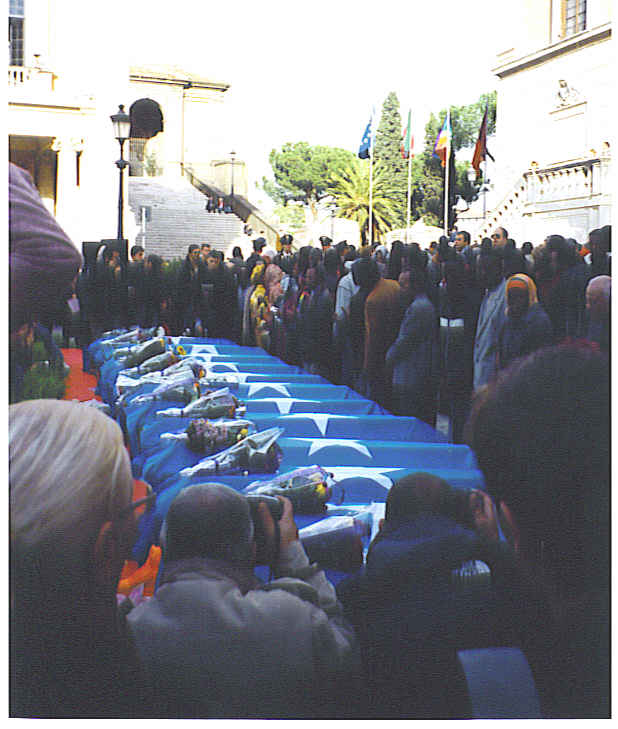
We walked by Teatro di Marcello looking for the forum. We knew it was visible from the Capitoline Hill but we didn’t have our guidebook. We started to climb steps in order to see where we were and the Roman Forum was staring us in the face. It spread out with its avenues and temples in disarray, the ever-present scaffolding, and the Coliseum hovering in the background. We worked our way to the steps that Michelangelo built as part of his renovation of the Piazza Nuovo in the 1600’s and came upon a crowd. We heard music and thought it was a concert. What we saw were TV cameras, several coffins, hearses, and Africans in traditional garb who looked distraught. A guard explained that last week a boat going from Africa to Sicily went down. We’ve been so out of touch with the news. These were the bodies of thirteen priests who drowned. Forty people were lost in all. There was a long line of pallbearers to place the coffins in the waiting hearses. We were so moved by the tragedy.

On our way to the Pantheon we saw a monk who was a dead ringer for Friar Tuck except that he was wearing sunglasses, a baseball cap, and was using an enormous umbrella as a walking stick. It was a photo-op without the opportunity. The Pantheon was closed today for a twenty-four-hour strike. Someone asked who was striking. David said it was the gods.

I think Romans still consider having a stone phallus outside a building to be good luck. They’re lining the avenues and are used as barriers for pedestrian areas. There’s no mistaking them after seeing the real deal in Pompeii.

It was 5 PM and we were hungry so we stopped for a slice of pizza. I went to use the toilette and on the stall door was carved, “save Israel.” We have friends in strange places. We wandered over to the Tiber River to stroll along its banks until services began.

Judaism Romano

There was a large crowd for services. I followed some women and ended up in a basement chapel at a private pre- bar mitzvah service. I went up to the main sanctuary and found the women’s balcony three flights up. There were signs cautioning the women not to talk. They were ignored. I noticed that several of the women arrived carrying motorcycle helmets. It’s a swingin’ set of Jewish matrons they have here. The décor was plainer than in Florence, but still had the painted walls with floral motif and matching stained glass windows. It was a more Romanesque feel with soaring marble columns and vaulted ceilings. After forty-five minutes of not recognizing anything I gave up and went down to wait for David. I met a French woman and had a nice chat. My French was good enough to determine that her husband was in the sanctuary, she wanted to leave, they were on vacation, and she was having a good time. Not bad for forty-year old French classes. I was relieved when David emerged and said he understood little of the service as well. Not only were the tunes different but also several of the prayers were unfamiliar.

Now it was 7 PM and David was still hungry. He has wanted a hamburger for days and couldn’t resist Burger King. They had a hot chili Whopper that turned out to be covered in BBQ sauce. The menu was in what resembled English. His burger was touted as “Wester” BBQ. The tally for a burger, fries, and medium coke was EU 5.40. It was a very expensive food day.

Tomorrow we take an afternoon tour of classic sites. That means we get to sleep late.

Toby

Saturday, January 1, 2011

Amalfi Coast


October 23, 2003-Curves Ahead!

(photos: Cathedral of many steps,
Barely supported coast road)

Today we were between a rock and a wet place. David made his decision not to drive the Amafli Coast road. I seconded and thirded it.

We took the bus into Sorrento to catch the bus to Amalfi. That was going backwards to go forward, but we had a reason. The Amalfi bus stopped in Meta near the train station and our hotel but by the time it arrived there was standing room only. We reasoned that if we caught the bus at the beginning of the run in Sorrento we’d get a seat. We were right. I knew we’d been on the local bus route to Sorrento too often when I started recognizing the laundry on the lines. It’s rained each night so things like jeans haven’t dried in several days. I also noticed that the set-up of stores hasn’t changed since Pompeii. They’re still about the size of a 1 1/2-car garage and have sliding doors in front.

It’s said that Americans are first in line and the last to get onto the bus. That almost happened to us. David was using good manners and letting little old ladies ahead of him when I realized that I was probably the same age as they. I encouraged him to push ahead and we got on. We had to decide whether or not to sit on the cliff/sea side of the bus or the mountainside. The seaside was more scenic and scarier. The mountainside was “safer” but the view was intermittent sea with scattered glimpses of houses. Our choice was made when there were no seaside seats.

Fortunately, at the first stop, Positano, enough people got off so we could switch sides. I don’t know if that was wise or not. David got car/bus sick and my neck got stiff from all the switchbacks. The curves were so severe, the lanes so narrow, and the visibility so poor that drivers use roadside mirrors stationed at each curve to see what’s around the bend. There are hoards of tour buses going in both directions along with various bicycles, pedestrians, scooters, cars, and construction vehicles. At times the buses had to fold in their side mirrors. If the windows of the homes we passed were open we could have easily reached in and taken food off kitchen counters. It was small comfort but there were two-foot high guardrails and walls. It was probably after we saw goats on the side of a hill that I noticed the underpinnings for the side of the road we were on were non-existent. The mountain supported two-thirds of the road but a full 1/3 was just hanging out there. I conscientiously pointed it out to David so he would be as fully informed as I.

Picture Perfect

Even with our hearts in our throats, David’s stomach in his mouth, and my neck wishing it was in a sling, I did notice the glorious scenery. Blue clematis and fuchsia bougainvillea climbed everywhere adding bold color to the soft tones of the buildings. The hotels and homes, most with swimming pools, were built up or down the slopes with terraced gardens, grape vines, olive and orange groves adding to the greenery. The ragged harsh cliffs rose above and fell below to the bluest sky and turquoise water.

Amalfi was a picture postcard town. The cathedral, built in 987, and the basilica, built in 833, were reachable up a long flight of steps. What else? The Moorish bell tower had a colorful ceramic tile roof that seemed to be a popular style on the coast. The sign at the top of the steps said that the cathedral was closed. It would have been kinder to place the sign at the bottom of the steps. The alternative was to pay a small fee to see the museum, cloister, and crypt so that we could enter the cathedral from an interior door. We paid and were greeted with the resting place for the body of St. Andrew, pictures of rape and torture, and silver reliquaries that held or still hold skulls of saints. It was the usual holy blood and gore. The inlaid marble designs and frescoes distracted me from morbid thoughts and added beauty to the otherwise depressing collection.

We ate a panini lunch in an off-the-beaten-track café. It was relaxing to watch locals do business and visit. The vegetable vendors were particularly captivating. There were three generations of men involved. As 2 PM approached they prepared to close for the afternoon. I could see the pride they took in their stand as they carefully packed the produce, swept the sidewalks, and cleaned the counters. They chatted and laughed as they worked, fully aware they’d have to repeat that task at night. It led us to speculate about what Italians do during siesta. I think they make more Italians. There are certainly a lot of babies here. It’s not a time when they can run errands since all the other stores are closed too.

It was time to leave Amalfi so I went in search of a bathroom. We were outside a rather prosperous looking hotel. I walked into the lobby as if I belonged and eventually found an immaculate toilette. I locked the door with the key provided. I was somewhat disconcerted when I tried to leave only to find that the key wouldn’t work. I tried many times, but had to pound on the door to get attention. A puzzled male voice asked what I presumed was, “Is everything OK?” in Italian. I responded in my very best English that, indeed, it was not. Resorting to long lost Latin, I referred to the key as “clef.” In my desperation I slurred the word so that it sounded a bit French as well. It worked. He fell back on broken English and suggested I slide the key under the door to him. It was an old fashioned very thick key, but due to the lack of Italian’s concern for flush fittings, it slipped right under. He opened the door and I stepped out saying, ”Voila!” He clearly didn’t know what to make of me. I scurried away to find David who was sitting outside wringing his hands and gazing at the bus that was soon to depart. I wonder how much longer until he would have retrieved me?

The driver back to Sorrento was more of a hotdog than the one to Amalfi. He whipped around the curves so fast that at one point the luggage door on the side of the bus opened and luggage flew onto the road. He slowed down after he picked up the bags and secured the door. I suggested duct tape, an American stand-by.

Our Siesta


We skipped Positano, another coastal town, and decided we needed down time at the hotel. We’ve been getting up early and I’ve been staying up late to write. When we tour in summer we usually need a nap to escape the heat. The weather here has been so pleasant we’ve stayed out from 9 AM to 10 PM without a break. Wine and cheese in the room sounded good.

It started to rain as we got off the bus in our town of Meta. The stores were still closed so we went directly to the hotel. We had umbrellas but our shoes and socks were soaked. The sun came out as we walked into the hotel. We did email and thought by that time stores would be opening. I went up to the room to dry off and use the hair dryer on my shoes. David went in search of refreshments. It was an hour before he returned. I was beginning to worry and didn’t know where to begin to look. I hadn’t heard an ambulance so I assumed he hadn’t been run down. He could have easily gotten lost in the maze of streets. All I could do was wait. I figured that he had ID and that if he was arrested, injured, lost, or dead, the authorities would notify someone in the U.S. and I would eventually hear via email.

He returned triumphant if a bit weary. Stores in this neighborhood close on Thursday afternoon. Maybe this happens all over Italy. I guess they need more babies. He wandered from closed mini-market to closed wine shop until he found a green grocer who was cleaning up for the day. He talked him into parting with a wedge of Parmesan. Wine we got at the hotel bar. The poor man is napping now.

We return to Rome tomorrow. The car has to be at the rental office at the train station at noon. We’re three hours from there but will leave an hour to get lost.

Toby