Tuesday, June 17, 2014

Sicily-Catania

Gardens

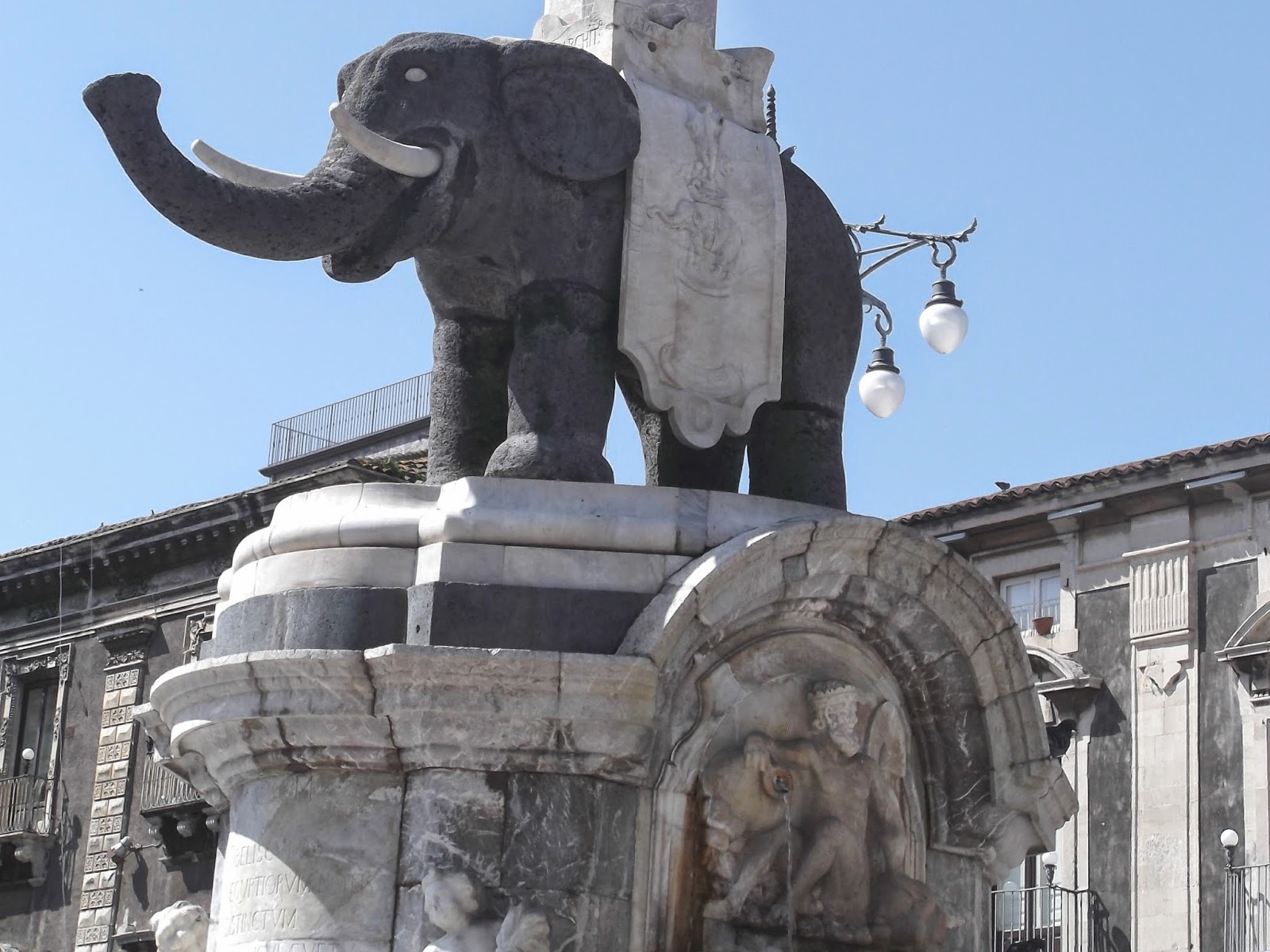
Symbol of Catania

Friar Tuck Outside Cathedral

Amphitheater & Fetid Water


April 7, 2014

Bad

I just can't resist quoting from the guidebook again. "...when the mayor of Catania proposed making a bid for the Mediterranean Games, people turned out in big demonstration against it-the anti-games leaders weren't shy about saying that the embarrassment of showing their city off to  the world would be a little too much to take." It goes on, "...for now, you can cruise the streets of this perfect dystopia & enjoy the aroma of an urban carcass that is rotting away." Strong words.

Decrepitude, that's another strong word. It's my opinion of Catania. Living here would be like living in a New York subway. OK, I'll cut it some slack. It doesn't smell as bad as a subway. The saving grace, the jewel in the thorny crown, the oasis in the maelstrom is Giardino Bellini. It's an elevated city garden reached by climbing a grand staircase of black & white inlaid stones. It is complete with quiet paths, a gazebo, & a view of Mt. Etna. It is a carefully maintained retreat amidst the rot. A floral clock is its centerpiece & it claims to have the largest fig tree in the world.

To be fair, I must mention that, given its history, Catania is holding its own. It has been destroyed by Etna, earthquakes, & armies seven times & has re-built. Maybe they're tired. Maybe they're superstitious. They may think that if they don't take care of the city noone & nothing will devastate it again.

We made our way towards the old city (quite a hike) & encountered the largest outdoor market I've ever seen spanning several city blocks. There were "departments" catering to foodstuff, clothing, household goods, tools. You name it; it was there. A woman stopped me & with gestures & rapid Italian indicated I should put my purse under my jacket. I was wearing it cross-body purse under my jacket but it stuck out at the bottom. I shortened the strap & was able to conceal the entire purse. I looked about six months pregnant but no one was going to try to nab this "baby." It drove home that the reputation of Catania was valid. It's a dangerous place.

We reached the Piazza Duomo & were disappointed to see scaffolding covering the entire altar of the Cathedral. Of interest were ruins of Roman baths around which the seating was arranged. The pulpit & some statues were of carved black lava & Bellini, the composer, is buried somewhere in the church.

Worse


We walked through a nearby city gate & gawked at what must have been an impressive palazzo. Back we went through the gate & opted to find something really old, the Greco-Roman Theater & Odeon. We qualified as seniors after showing our U.S. driver's licenses & entered a small museum leading to the amphitheater. The usual background here: Greeks built it, Romans modified it, Normans stole the marble for the Cathedral. We wandered in the dark through what we assumed was "backstage" & emerged at the top of the facility after climbing many rotted wooden & crumbling lava stone steps. It was a shambles compared to the one in Taormina. Where the stage had been was now a collection of fetid water. Garbage was strewn all around as it is in the rest of the city. No pride.

We walked back to the area of our hotel via Cruciferio St. It's lined with Baroque villas, convents, & churches all in need of a good sandblasting. We tried to imagine what it would look like scrubbed clean & agreed it could be a marvel.

Lunch was calling us. I must admit I've misread signs that say "Catanese" as "Cantonese." Wishful thinking, I guess. I'm ready for a different cuisine. We ended up at a trattoria/pizzeria where we ordered pizza & watched as it was delivered from the take-away stand next door. Among other delicacies we chose not to order, the menu included what was translated as "pickled newly born baby fish." The other languages seemed to corroborate the English version.

We returned to our hotel & collapsed until dinner. The restaurant recommended by our hotel wasn't open yet so we walked across the street. Il Quarticciola Ristorante was only two weeks old but they had their act together. A server with excellent English walked us through the menu. They gave us gratis champagne & an after dinner drink & we left feeling sated & cared for. We took a stack of their business cards & gave them to our hotel.

Judi, David, & I are happy to be going home. I hope Judi thinks it's been worthwhile. She's a real trooper.

We leave for the airport tomorrow at 4:45 AM. Lights out will be early for us. I'm resigned to opening our windows & swatting mosquitoes again tonight. I'll have lots of time to sleep on the plane tomorrow.

Toby

Italy to Sicily & Catania

Inlaid Tiles-Cathedral in Reggio

Katani Palace Hotel Dining Room


April 6, 2014

Accidents

Jon Lucca met us for our trip to the main museum in Reggio Calabria. It's an old building redone with stark white walls & soaring ceilings. We were there to see the Riace Bronzes. These treasures are so well protected that we had to wait in an anteroom until the air in that room equalized in temperature & pressure with the room where the bronzes were displayed.

In 1992, a man was scuba diving 600 feet off the coast of Riace, Calabria. He saw what he thought was an arm sticking out of the sand at only three feet deep. I don't know if his first thought was he'd found a Mafia "hit," but he notified the police. He had stumbled upon 5th century BC Greek bronze statues that are the only intact bronzes of any size in existence.

The theory is that the bronzes were on a ship going to Rome when the ship sank. Either the ship broke up close to shore & remnants went out to sea with the statues sinking in the sand, or the statues were thrown overboard to lighten the load in an attempt to save the ship. Rome appropriated Greek bronzes & transported them home to use the bronze for weapons. Fortunately smaller copies were made for display in homes because that's how we know what the originals looked like. In the 1400's, many more bronze statues were melted to be made into cannons.

The statues are about seven feet tall, hollow & have a very thin delicate bronze skin although they look massive. Statues of regular people were cast in life-sized proportions, but heroes & gods were bigger than life. These two warriors must have been some kind of heroes. Their eyes, teeth, & even lips were original. Ivory & onyx was used for the glaring eyes while the teeth were made of silver. The soft rose hued lips were copper. The musculature was incredible & veins were prominent as if each soldier was engaged in a strenuous act.  Judi observed that the Greek bronzes had Roman noses.

We reluctantly left the bronzes to take a look at equally old marble figures, Castor & Pollux, found in Loci. The twins, gods who served Zeus, were cavorting on a wingless horse supported by a sphinx. Although wingless, the horse portrays Pegasus. It wasn't until the Middle Ages that wings were added. I guess the limited imaginations of medieval men couldn't conceive of something flying without wings.

Further along there were more statues of the twins & a central female figure found at a Temple. The female was not identified as any specific goddess, but Loci was a matriarchal society. I asked Jon Lucca if it was possible the goddess was Hera, Zeus' wife, since she was with Castor & Pollux, his gofers. He thought it was as good a theory as any.

A huge tapestry hung adjacent to the statues & portrayed a scene of Castor meeting up with some unidentified person. It was hand woven silk. We learned that before olive groves were so plentiful there were countless mulberry trees & the silkworm industry flourished in Calabria. Marco Polo? When machine loomed tapestries began to be manufactured, oil was needed to run the factories. That's when mulberry trees were replaced with olive trees. Olive oil lubricated the Industrial Revolution.

Other small statues were around & Jon Lucca explained that as with the deities in the Tarxien Temples in Malta, images of nobles & rulers were made so their heads could be removed when a new dynasty took power. Very practical. The mileposts for the Roman roads were also designed with one end carved with the name of the emperor & the other blank.  When a new regime took power, they flipped the stone embedding the old end into the road & carving the name of the new leader on the blank side.

Forging Ahead


In 1908, there was a devastating earthquake & tsunami here. Twenty-five thousand died in Reggio Calabria & seventy thousand in Messina. During the clean up, Roman baths were discovered in downtown Reggio. Why not? We strolled past them on the way to the cathedral rebuilt in 1928. Only the altar & one chapel survived the earthquake. The story goes that St. Paul was shipwrecked in Malta, as we all now know. After preaching there, he was enslaved by the Romans. While being transported to Rome, they stopped for a short time in Reggio Calabria. Paul managed to convert St. Stephen of Nicea & made him a bishop. That established Reggio Calabria as the first diocese of the Western church. Statues of both saints stand in front of the scaffolding behind which the church facade is being restored.

The restored cathedral was built to reflect the architectural influences from its past. The surviving original chapel walls are done up with multi-colored marble geometric inlays of blue, brown, & white swirls. It's a busy design but works to create a calming atmosphere. Above & to the sides of the altar in the chapel are our old friends, white stucco menorahs.

Our time with Jon Lucca had ended. He took us to the ferry boarding area near our hotel (it's maybe two blocks away) & made sure we were set to board in the afternoon. Our driver,  Angelo, called from Messina, Sicily, to double & triple check our arrival time.

We killed the afternoon walking through a flea market that didn't have any sox for sale. We had  lunch & joinied Sunday window shoppers. Soon it was time to get our luggage & board the ferry. It was downhill all the way to the dock. The ferry was on time. We had no steps to climb or escalators to deal with. There were no railway tracks blocking our path. Easy peasy.

We caught a glimpse of Etna as we crossed the water back to "Sitaly," as I've been calling it. Angelo was waiting & we headed south through many tunnels to Catania. Etna grew bigger as we approached. It was like seeing an old friend. Steam was pouring from the caldera creating a thick halo overhead.

We got to the Katani Palace Hotel & surprised the desk clerk who wasn't expecting us until June. The mistake was straightened out shortly when we realized there was a transposition in dates. Americans write today as 04-06-2014 & Europeans write 06-04-2014. That solved, he looked for the reservation under "Horowitz." Somehow it was listed under "Ritz." Our rooms are lovely & we even have a double vanity sink. But it was hot so we asked about the air conditioning. We were told that it's centralized & the owner has it programmed to go on periodically. We can keep the setting on "auto" but it will only control the flow of air, not the temperature. We ended up opening a window.

The man at the desk recommended Taverna dei Tre Conti for dinner. It was a short walk through what looked like scuzzy streets, but it's Sunday & the place is closed down. We read the menu before gong in & I noticed they had a bistechi dish they translated as "horse meat." I teased Judi that the tough "bistechi Marsala" she had in Palermo might have been "neigh" not “moo.” She said I'd never convince her of that. She ordered grilled swordfish tonight, David had veal, & I had an interesting tasty penne with fennel, raisins, sardines, & breadcrumbs.

Tomorrow we'll explore Catania on our own. My guidebook describes this city as, "by any measure, Europe's most degraded city, & the Catanese have no one to blame but themselves. Unlike Palermo or Naples, this city does not have the Mafia ...to suck its blood... Neither can it claim poverty as an excuse: Sicily's second city & main business center makes quite a good living from trade & industry."

Toby


Monday, June 16, 2014

Italy-Reggio Calabria

Synagogue Ruin Under Overpass

Mosaic Floor

Agrotourism Inn

Ghost Town

Damaged House in Ghost Town


April 5,2014

Historical

It's the first nasty day we've had. High of 59 & rain. It's a good thing we planned "indoor" activities. That didn't slow us down. Get ready for a long email.

Our hotel is the most basic yet, but its location right next to the ferry is ideal. Oh, right. Would have been ideal. Will be ideal tomorrow. At breakfast this morning we figured out there were four ferry options we could have taken yesterday: the ferry we took, the ferry we should have taken, the ferry that didn't come, & the ferry at an entirely different port that goes to Rome.

The hotel room has all we need except, perhaps, a desk light. I had to use a flashlight to read my notes. The aroma of breakfast greeted us with our wake-up call & the start to our day. The shower is high tech. It has four sprayers & I think David is in love.

Jon Lucca picked us up in a roomy van. He's quite an educated man & also guides for Road Scholar Tours. He studied for a law degree in Bologna, but didn't have the money to complete the exam. He studied English in London where he worked as a cook to pay the bills; then went to Pittsburgh to learn more English. He used to lead tours all around Europe, but when he got married his wife insisted he limit his work to the area.                                                                                       
On our way out of town we drove along what he told us was the nicest waterfront in Europe. We could see Sicily across the water & asked him about American's favorite stereotype, the Mafia. He confirmed that the Sicilian Mafia was into big business & government while the Calabrian  branch had taken over the drug trade. But Calabria itself is practically crime free. Calabrian ex-patriots work out of Columbia & sell to the U.S. & Northern Europe.

Our history lesson was brief but interesting. Calabria was settled by the usual suspects. Today there are concentrations of Greek, Albanian, & Valdesian communities. The Greeks arrived you- know-when by now. Valdesians fled from the South of France in the 1200's when the Pope wanted them to convert from Protestantism. In the 1500's, of those who fled to this area, over one hundred thousand were slaughtered by soldiers of the Pope. That created a problem. They were the labor force for the Church. The solution was to relocate Catholic Albanians to Calabria. Albanians were only too happy to oblige since the Muslims were moving into their turf. 

Judaism

Jews spread across Calabria & the rest of the Mediterranean. It is said that the village of Santa Maria del Cedro now grows etrogim (etrogs) brought over from Egypt by the sons of Noah. An etrog looks like a lemon on steroids & is used during the festival of Sukkot. To this day, many Israelis buy their etrogim from that village.

Carrying on with the theme of the day, Judaism, we arrived at ArcheoDeri, an archaeological dig named for the city, Deri, where it's located. We were met by a Professor Iiriti who is truly passionate about his subject. He was accompanied by three "henchmen" whose role was unclear. He spoke in Italian as Jon Lucca translated. It doubled the time of our tour but enabled us to absorb the information & gave me ample time to take notes.

In 1993, a road was being built when ancient ruins were discovered. An archaeologist tried to stop the construction, but could only reach a compromise. The road would be built but had to be elevated over the synagogue & graves. That was an advantage to us. It started drizzling & we ducked under the overpass. Among the remnants of foundations found were a synagogue dating from the 4th to 6th century & a mikveh (ritual bath). The town was used as a way station for Roman troops as they marched along those famous Roman roads, & commerce increased.

There used to be a large Jewish community that began to arrive after the destruction of the Temple in Jerusalem, 70 AD. One theory said they fled here on their own, but there is evidence some of them were sent to Rome as slaves. They eventually bought their freedom, headed south towards home, & settled here. After time, the community bought a Roman villa on which site they built a synagogue. Evidence shows that the village covering fifty acres was abandoned after a fire in the 6th century. It was the time of the Plague. Jews were blamed because they weren't dying in the vast numbers that Christians were. We now know that the Jewish custom of ritual bathing (monthly for women, more often for men) rid them of the fleas that caused Plague. The Jewish sector was torched.

The museum at the dig exhibited articles attesting to the commerce & seafaring of nine thousand years ago. Neolithic artifacts (surgical instruments & decorative clay wall remnants) attested to the development of the arts & science. Survival wasn't the only goal. These people had honed skills needed to just exist & now had the luxury to plan for the future & beautify their world. A most fascinating object was a remnant of a globe shaped ceramic time piece (1st-2nd century AD) testament to their knowledge of Meridians & that the Earth was round. Somehow, in the Middle Ages, the Church went backwards & tried to quash that information.

The centerpiece was the mosaic floor lifted from the synagogue & placed in the museum. One symbol that is the emblem for the dig is "Solomon's knot." We'd never heard of it. It looks like the Celtic knot & is supposed to symbolize eternal knowledge. Have to check on that. Twelve geometric medallions (plus four more for symmetry) surrounded a central design that included a menorah flanked by a shofar & etrog. From each of the seven branches grew a pomegranate sprouting a wick. Imprints of menorahs were stamped on oil lamps & food amphora as a sign that it was kosher: an ancient hechsher (certification). The visit was literally a thrill a minute. Even though scholars knew there were Jews in Calabria, the discovery of the symbol of the menorah was the first tangible proof.

Our local guide, Professor Iiriti, wasn't finished yet. He took us down a long unpaved road to a document center that was a not-quite-opened museum of the area. He turned on a recording of Sholom Aleichem as we entered & we watched slides of what we'd just seen. We wanted to pay "dottore" for his time & enlightenment, but when asked, he told us he wasn't permitted to accept money. The government has been slow in doling out funds, but he hopes to renew excavation in October.

While we were with an expert, we asked about the name or our friend, Cimini, whose family hails from Calabria. The professor immediately identified it as an old Greek name. It turns out the professor was half Greek & half Jewish.

Ghosts & Gobbling


We were hungry by now & in for a real treat. Jon Lucca drove us up a mountainside over roads that even made him nervous. We were going to his friend's agrotourism property. It had been in the same family since the 1600's & originally grew bergamotte fruit. It's a type of citrus that refuses to grow anywhere but in coastal Calabria. It's notably used in perfume & it's made into wine similar to lemoncello. If the seeds are planted, they grow into trees with sour oranges. The bergamotte only grows from a graft onto the root of an existing tree. I know, it's a chicken & egg thing. The property, Il Bergamotto, now doubles as an inn with a restaurant. The remains of a castle look down on aged buildings constructed of stone & tile. The height of the doorways speak to the stature of the original owners, and the food keeps locals coming back for more. A nearby table hosted a priest with an entourage of villagers from the hill town of Amendolea.

Our feast, the best meal we've had on this trip, was prepared using only local ingredients. The flavors were rich, robust, & original. The meal began with wine & antipasti of bruschetta, cheeses, thinly sliced pumpkin sautéed in olive oil & seasoned with breadcrumbs with pecorino to top it, roasted eggplant, & spinach pie. That would have been enough, but then our orders were taken for the "primi pasta." That was hand crafted pasta one vegetarian & one with a delicate lamb flavor although we couldn't find evidence that a lamb did any more than walk past during cooking. The server had the nerve to ask if we wanted the next course. I now know why Italians need a four-hour rest after lunch. We settled for espresso & a taste of bergamotte wine. The wine had an orange flavor & wasn't as tart as lemoncello. The espresso came in plastic cups that wouldn't fly in the U.S. They & the sugar packets had the brand "Mocca" printed on them along with the picture of a black-faced grinning Sambo caricature.

Being the age of our children & having the energy of someone that young, Jon Lucca suggested we visit a ghost town, Pentedattilo . Who were we to argue? Of course, we drove up a mountain until we were looking up at an abandoned village. The houses, some roofless, were cement color stucco blending with the rock into which they were built. It was clear no one lived there. Towering over the village was a formation of limestone & sandstone fraught with caves & topped with a relic of a castle. There-in was the problem. The stone is porous. Erosion caused it to be unstable & when massive rains & floods occurred in 1954-55, landslides created havoc. The people left for towns lower down & are only now beginning to re-claim their homes with government-assisted funds.

It was quite a climb from the parking area to the village. A golf cart was available for those who didn't want to walk. We saw the cart up in the ghost town so we waited for George, the driver, to descend. We got impatient & began the climb. It was steep, but not far. Judi stopped halfway & the cart eventually picked her up on its next trip. The views from the top were breathtaking including the ones looking down into the smashed roofs of the houses. The panorama of the sea, valleys, riverbeds, & sheer cliff faces brought home just what a prime defensive location it was.

George latched on to us. With the energy of a puppy & enthusiasm of a missionary, he launched into the history, a tour of the museum fitted with old implements, & a pep talk about modern weddings conducted in the church. He loves driving women in high heels up the hill. Rain didn't deter him; slippery stone pathways didn't slow him down; our flagging interest went unnoticed. The government has allowed artists to display their wares in unused space & he jubilantly introduced us to his wife who was one of those artists. The entire tour was conducted in such animated Italian that Jon Lucca didn't need to translate very much.

We road down to our van in the golf cart & bade George a fond farewell. It was late, we were tired, & were encouraged when Jon Lucca headed to the hotel.

Although we were impressed with the difference between Calabrian & Sicilian drivers, (Clabrians actually stop for pedestrians) it was pouring down rain, & we chose to eat in the hotel. We ordered in pizza & had one of the worst meals of our stay. But the crust was thin enough to get us in the mood for Passover. We ate in the hotel breakfast room as we gazed at the glistening lights of Reggio Calabria & Sicily.

David & Judy conducted some high finance to even up the expenses & came to within $30. We bought dinner. Now we're even. We arranged a wake-up call with the desk clerk who spoke English. He goes home at 9 PM. Last night David did a pantomime for the night clerk & managed to get the message across but wanted to skip charades tonight.

Tomorrow Jon Lucca meets us for a trip to see the Roman Bronzes then we transfer by ferry back to Sicily.

Toby

Sicily-Cefalu-Messina


Duomo in Cefalu

Seashore-Cefalu

La Rocca-Cefalu


April 4, 2014

Wrong Timing

We returned to Pizza e Cucina for dinner last night. Of course, they remembered us. The grandfather of the owner was there. He was told about the singing the night before. He was on his way home to bed, but he wanted to meet us for lunch the next day. We told him we'd be leaving for Cefalu & he said they had a restaurant there too. As a token of friendship, he gave us three slim slices of pizza crust with something special on it. We ate the bite-sized morsel as he tried to explain what it was. No one there spoke any amount of English so he drew a circle on a piece of paper with what seemed to be hairs around it. Then he wrote "300." We guessed fish, but he said "fruit de mare." Uh oh! We then guessed calamari, octopus, & on & on until we got to sea urchin. Bingo!

We left the hotel this morning & made it out of Palermo the hard way (is there any other?), eventually found the autostrade, & were on our way to Cefalu. The guidebooks call it a resort town. It was settled in the 9th century BC; it is now well restored & lined with boutiques, restaurants, & gift shops. We followed the seashore to our left & mountains on our right. Industrial zones gave way to prettier hillside villages of typical tan stucco houses & with red tile roofs. Eventually, Le Rocca, a mountain, appeared looming over Cefalu on one side as the fine grain sandy beach embraced it on the other. Parking was dicey but we managed to find a free lot near the old city. The Basilica closed at noon so we race-walked into the square. As we entered, David had a sinking feeling he forgot to lock the car. We arranged to meet near a grouping of cafes & he took off. I won't even mention the up & down hills.

The 12th century Duomo (basilica) was disappointing. It was billed as reminiscent of Monreale but the only resemblance was the altar area. That part was embellished with gold mosaics & definitely focused the eye from the cold stone of the rest of the church.

Judi & I walked the streets a bit then met up with David & ate lunch at a delightful beachside cafe. Time was fleeing & we had to leave. We had to be at the ferry in Messina by 4pm to return the car & get to the boat.

Wrong Placing


We had autostrade all the way & it would have been scenic except for the tunnels. I don't know what the route was before this highway was built, but it must have been hell. I have never driven through so many tunnels on one road. Can't imagine what it would have been like if we had to go around each mountain. Our Lady had conniptions & kept losing the signal.

The GPS found us in time to get to the Hertz car rental place & gas station for a final fill up. We had a surprise when we turned the car in. The odometer read that we'd put 33,000 kilometers on the car while we had it. That would have been some trick. We had unlimited  usage so it must have been a mistake made when we picked the car up at the airport in Catania. No worries. David is majorly happy to be rid of that car. We gave him a huge “atta boy.”

Our itinerary said the ferry was a two-minute walk from the car drop-off. The Hertz guy said it was more like a kilometer. He then asked us which ferry we were taking. We didn't have the name but knew where we were going, Villa San Giovanni (Reggio Calabria). We called Viviana, our Sicilian contact, who said there was only one ferry. When I mentioned being met in Calabria she said she wasn't responsible for any arrangements there & to call the agent in Reggio.

We had to take a taxi to the ferry & the driver also wanted to know which ferry we were taking. We told him where we were headed & he dropped us off at a ticket office. We bought tickets & got in line with a bunch of Italians who confirmed this was the correct ferry & that it also carried cars, trucks, & trains. Across the dock we saw a small, passenger only ferry loading, but we were sure we were in the right line. We called the agency in Reggio Calabria to tell them when we'd arrive & we waited some more. An hour later there was still no ferry for us. The Italians started to bail & we followed. Our money was returned for the tickets & we heard that our ferry wasn't coming anytime soon. We sprinted over to the other side of the dock following the crowd & got onto a Bluferry boat.

We called our contact in Reggio to learn he was waiting at another dock but he'd meet us where we were headed. It was only a twenty-minute boat ride, but getting off was a mess. We had to haul our luggage up stairs to get off the boat, up an escalator only to find out we were on the wrong side of railroad tracks, down steps, up another escalator, & there was a sight for sore eyes: Jon Luca. He will be our keeper for the two days we'll be here.

The wrong ferry took us to San Giovanni, about twenty kilometers off the mark. If we'd been on the right boat, the Ustica Line, we'd have landed a few steps from our Hotel Continental. We can look out the window of our room & see the port. Jon Luca was most gracious about his diversion. We were most annoyed about the insufficient information on our itinerary & Viviana's ignorance about the name of the ferry line. Jon Luca assured us it would go much more smoothly for our return to Sicily. I have confidence in him.

We walked to Le Palme for dinner & enjoyed pizza with dried salt beef, eggplant fritters, & homemade gnocchi. Tomorrow we meet Jon Luca & take off for Bova Marina, an archaeological dig.

Toby


Friday, June 13, 2014

Sicily-More Palermo

Teatro Massimo

Palermo Cathedral

Martyred Priest


April 3, 2014

On Our Own Again


We left the hotel in plenty of time to grab an English speaking tour of Teatro Massimo. It's one of the first opera houses built in Italy. Construction started in 1875, & was completed in 1897. It has the second largest stage in Europe. It’s palatial in scale & design with red plush seats & private anterooms & box seats for royals. Chestnut wood was used to surround the shoe shaped theater creating perfect acoustics. Performers shun microphones & since music is the raison d'être, air-conditioning, a modern addition, is avoided due to its noise.  The frescoed dome was built so that each panel opens to a window for ventilation, & to this day, it is the preferred method for air circulation. Originally, there were no seats in the lower level. The less advantaged stood as commoners did in The Globe Theater, & nobles sat in the six tiers of balcony. Today, all attendees must be seated & prices vary.

Known world wide as the setting for shooting Godfather III, the theater has another dark past. A church was torn down to build part of the Teatro Massimo, & it is said there is a phantom at this opera house. A nun haunts the stairs we took to descend after the tour & we were warned she's been known to trip people :)

We walked over to the Cathedral passing stores selling vestments. I don't think they'd sell to the likes of us. We were warned that the exterior trumped the interior so were prepared to be disappointed. We were. Built around 1185, it's a Cathedral built on a Basilica, built on a Mosque. It is plain, uninspiring, & depressing. The exterior is a melding of what we're used to seeing by now. Its multi-faceted architecture echoes the culture of whoever put a hand to it over the centuries.

Yesterday, I wrote that Raffaella told us there were no more Mafioso in Sicily. She said they were all in Miami. Today, in the Cathedral, we saw proof she's wrong. There was a memorial display of photos of the life of a priest recently martyred at the hands of the Mafia.

Our personal best at being lost came when we were resting on a park bench on our way to the Abatellis Museum. We'd entered through a gate & walked through Piazza Marina, a park, thinking there would be an open gate on the opposite side. There was none. We wandered around until we found the gate we'd entered & escaped to the museum.

The Abatellis is housed in a 15th century palace. The artwork is from the 12-16th century & some of the works reflect the influence of Carravagio who lived in Sicily for a time. Most of the art is religious in nature with smatterings of gore per the stories the art was depicting. My favorite was someone's intestines being eaten by birds while he was still alive.

We were so tired when we reached the museum, that at one point we were seated near the elevator & asked who of us was going to get off the bench & push the button. No one moved. We realized we'd been on our feet for six hours with a half hour break for lunch. It's warm today, in the low 70's, & it has taken its toll. We've walked miles on sore feet in the last three days. We skirted the waterfront then headed back to the hotel. We needed gelati & David tried eating it the Sicilian way, in a brioche. Tasty, but messy. There was nowhere to sit down so we trudged along. It was uphill, of course.

Tomorrow we drive to Cefalu, a seaside town, & Messina where we return our rental car. We then board the ferry for a twenty minute crossing to Reggio Calabria in the south of Italy. For the next few days we'll have a driver. A pleasure.

Toby

Sicily-Palermo

Church of the Immaculate Conception

Capo Market

Old Jewish Quarter


April 2, 2014

Self-Guiding

Breakfast at the Hilton is the best yet. We feasted while we organized our day mindful of our date with the guide this afternoon. We didn't know what she'd show us so tried to avoid obvious venues.

We walked down a divided boulevard toward Teatro Massimo, a concert hall. The exterior is a beauteous structure that we were eager to see. Unfortunately, tourist season has begun & the English-speaking guides wouldn't be available until tomorrow. As we left, we heard trumpets playing. We followed the sound of practice scales to a portico on the side of the theater. Two men were taking advantage of the acoustics of that outdoor space & we enjoyed their session.

We asked directions of the polizia to San Augustino Church. It's an unassuming medieval building nestled into the chaotic architecture of the Capo. The white interior & stucco statues offer a sense of peaceful contemplation. Decked out in purple for Easter, this church is the antithesis of the Cathedral in Monreale. From its 14th century rose window to its cloister, to its tasteful gilt wood, it speaks serenity. That was until we took pictures in the cloister area. We'd openly snapped away in the sanctuary, but a man told us in no uncertain terms we had to cease & desist. He then indicated by scowl & gesture that we had to leave. Not until we were in the doorway did we realize it was closing time.

We were on the edge of the Capo district, one of the oldest in the historic center. It was known as a home to slave traders & is now home to what looked like low-income dwellers & many immigrants. We'd heard of the outdoor market but didn't realize it wasn't only food-stuffs. It was obvious locals shopped there for everything from lamps to bedding to hardware. Certainly there was food, & we sidled out of the way of motorcycles sharing the narrow aisles with us. 

We stumbled on the Church of the Immaculate  Conception. The door was open so I peeked in. A woman leaving said there was a E$1 admission fee but it was worth it. I'd say so! Built in the early 1600's, it was a Rococo wannabe. Technically Baroque, it was entirely decorated using inlaid marble & semi-precious stones. Some were geometrical designs & some depicted Biblical scenes. Although not as skillfully done, it reminded me of the technique used at the Taj Mahal. Its busyness was a contrast to the calm of San Augustino.

We wanted to eat a quick lunch to allow time to meet our guide. We chose poorly. We placed our order & began the long wait. We joked about how they were probably sending out for our food, & we were closer to the truth than we thought. We sat outside looking at our watches when a man walked down the street carrying a large white insulated box. Again we joked about carryout as he walked inside our restaurant & unloaded plates of food. Our waiter picked them up & carried them to our table. Lunch had arrived. We watched as the deliveryman picked up the now empty white box, walked across the street, & into a building.

Guided


Raffaella was our guide this afternoon. She was very personable & had spent a year studying English literature in Asheville, NC. When asked about Jews in Palermo & the Mafia, she assured us there was none of either. She joked that the Mafia were all in Miami, Florida.

She said that Palermo was settled by Phoenicians in the early 8th century. The layout of the area of our hotel was prompted by a rich wine merchant who, in the 1900's, wanted to create a European feel. The boulevard I mentioned before was am homage to the Champs Elysses. It echoes the art nouveau popular then.

It must have been an hour before we arrived in the old section, the Baroque, after what might have been the most expensive hike ever. Remember, we paid for this tour twice. We arrived at the Four Corners, which marked the center of the old walled city & branched out from there. In Bellini Square, we were surrounded by buildings ranging from the 12th through 16th century. A fountain decorated with obligatory male nudes was the centerpiece. The best part of it all was that a convent with cloistered nuns sat on that square & there was no way for the nuns not to see that fountain. For whatever reason, the nuns had the noses of the statues cut off. That wouldn't be the part I thought they'd go for.

The next church was a 12th century marvel, the Martorada. It pre-dates the cathedral in Monreale but has the same gilt mosaics. Built as a Byzantine church, it still follows the Greek Orthodox tradition. The Normans, who were "the Northman," hailed from what is now Scandinavia. They conquered their way south to Italy & became Christians. They really wanted to get a foothold in Sicily & made a bargain with the Pope. They promised to build churches if he'd leave them alone. Being recovering Vikings, all they could build were ships. But, being clever, the hired Arabs, Jews, & folks from Byzantium to do the planning & execution. That's why the hodge-podge of Baroque walls & art with Moorish inlaid geometric floors. Columns from a mosque were added during an expansion with Arabic writing intact. To cancel out the Muslim, one small cross was etched into the marble.

At last we went deep into the slums where the newest immigrants now reside. Street signs were in Italian, Arabic, & Hebrew. We'd arrived in the remnants of the Jewish quarter. As with other areas in Sicily, Jews arrived here with the Romans after the destruction of the Temple in Jerusalem. In its heyday, before the Inquisition, Jews were about 5% (30,000) of the population of Palermo. The Moors left with the Jews during the Inquisition. Now N. African Muslims are returning as immigrants. Ironically, history is repeating itself. But evil was afoot even before then. Raffaella told us about Frederick II (13th century) who was a smart man in many ways but had a blind spot when it came to anyone who held power. He perceived the success of Jews to be a threat & instituted a law that they had to wear badges in the shape of a red star.

We were able to see a building labeled "meschita" that Raffaella said was a Sephardic place. We filled in the rest for her. That's what Sephardic Jews call a synagogue. It's the same root word as mosque. She explained that Jewish homes had been designed with a store below & living quarters above. That arrangement still functions today with the same trades being plied by the present occupants. There was a niche in the wall at an entrance to a multi-level apartment building reminiscent of European shtetls. Raffaella told us it was a place Jews used to keep a Torah so they could touch it when they entered. David introduced her to the word "mezzuzah" & told her what was written on that scroll. The government has recently realized that the "baths" used by a Sicilian family for centuries during the Scirocco (extreme hot winds) was actually a mikveh (ritual bath). They're trying to work with the family to restore it.

Raffaella gave us suggestions for sights to see tomorrow & I know we'll be walking that same distance again. She cautioned us not to return to the Jewish quarter since we'd be easy targets. Pickpockets, etc. leave tourists alone if they're with a guide. She also recommended a pizzeria near our hotel for tonight. Proximity was important. Pizza e Cucina was "typically" Italian with red checked tablecloths and singing pizza chef. He started out with the Italian national anthem, switched to the Marseilles, then people from Boulder, Colorado walked in. We launched into the Star-Spangled Banner & it was old home week.

I compared our quick ability to learn our way around cities to rats in a maze. Point us in the direction of food & we’ll find it every time.

Tomorrow we're on our own, on foot, & ready to search out more wonders of Palermo.

Toby

Tuesday, June 10, 2014

Sicily- Monreale

Car Sneaking Up On Judi

Silver & Gold in Monreale Duomo

Phallic Fountain-Monreale

International Holy Families


April 1, 2014

Mistakes

I look forward to writing at the end of each day, but as a reward I've been nibbling on chocolate. Just one square does the trick.

Judi also writes long emails home. When I read hers last night I realized I'd forgotten to mention the aqueduct we saw on our vineyard hike yesterday evening. It was more than half buried in the ground so the top was nose level to us. We stood on tiptoes & peered into the trough. I'd never been that close to a Roman aqueduct. It was stirring to actually see the channel where water flowed so long ago.

There's a learning curve when traveling. This morning David pulled the cord in the bathroom thinking it was a fan. Soon afterwards our phone rang. The desk wanted to know if there was an emergency in the bathroom. I feel so cared for ;)

Judi & I have been gasp-free for days now. But when David pulled into a space near the laundry we reacted in unison. What looked like a close call must not have been. We slid into the space with no bangs or crashes. Not only was the laundry place open, but our laundry was waiting for us. It was folded, sorted, & gift wrapped in plastic. Even our hotel laundry bags were returned. Well worth it. We pulled into the American style parking lot of Penny's Store, a grocery. We picked up a few necessaries & leisurely stashed the laundry in our luggage.

Finding Palermo was a piece of cake. Driving up to see Monreale was like driving round & round the levels of a multi-layer wedding cake. Parking outside the town but near the Duomo was obvious, & they even gave us a brochure for a pizzeria. They said if the restaurant stamped our receipt, parking was free. What a deal! We saved E$2 per hour.

We had lunch al fresco with about 200 high schoolers, mostly boys, at said pizzeria. Dining outside has its downside & it wasn't the well-mannered young men. The piazza of the restaurant was an ideal short-term parking place, turn around area, & throughway. Judi's back was to the action but David & I had a bird's eye view as each vehicle crept up behind her.

Missions

The main reason to go to Monreale is to see the Duomo. There's a saying, "Anyone who comes to Palermo without seeing Monreale arrives as a donkey & leaves as an ass." Norman kings were in competition for the biggest & best religious institutions. William II wanted to outdo them all. In 1174, at the age of twenty, he claimed that the Virgin revealed in a dream the location of a great treasure at the little hill town of Monreale. He promised to use the treasure to build a cathedral, thus rationalizing his use of huge sums of money for the project. The Pope gave him a special blessing, & construction began.

I often have a hard time seeing a lot of churches & cathedrals, but it hasn't been a problem on this trip. I knew I was in trouble when we entered the gold leafed, gold encrusted cathedral built on William II's lie. Gold & silver statues guarded the altar. I have never seen such opulence lavished on a place of worship. Artisans from the known world were brought to show off their skills. There is a definite Arab influence in the mosaics & Byzantine craft shown in the structure, design, flow, & artwork.

And thus the trigger for my angst & a reminder to you all that these emails are my gut reaction to time & place. How many faithful might have been fed with that silver & gold? How many victims of abuse could be remunerated for their suffering? The building was rife with hollow expositions of glory, prayer, & faith, but where was the holiness? Where was love of humanity? This was a tribute to the vanity of a man.

There was a gift shop, of course. We browsed around the postcard stand, & then I noticed cute figurines of what looked like children. On closer examination I realized they were all depictions of the holy family. They were labeled by country & ethnicity. There were Mary, Joseph, & baby Jesus as Muslims, Hindus, Africans, Eskimos & even Apache Indians. I kid you not. This was a global tour of stolen cultures. They just don't get it. 

Misadventures

Our travel agent had given us an Italian cell phone to use here. It rang as we exited the cathedral. It was the woman who was to be our guide in Palermo. She was at our hotel ready to take us on our 2:30PM walking tour. OMG! We re-read the itinerary & we'd missed it. We saw our arrival at the hotel April 1, but didn't read far enough ahead to see another listing for April 1, a 2:30PM tour. We apologized profusely & asked to reschedule. She was able to do so but at a price. Our fault. We'll pay.

With guilty hearts we continued on to the Benedictine cloister adjacent to the Duomo. It didn't seem worth the E$6 admission, but we're in so deep, we bought the tickets. It echoes the style of the cathedral with ornately carved marble & mosaic columns. There was what the guidebook called a "phallic" fountain that must have spurted water at one time. That was the excitement.

Descending the hill went well until we got into rush hour in Palermo. Believe me, you never want to experience it. David said he's never driven in that kind of chaos. Rome & New York City were easy in comparison. He's usually not an aggressive driver, but this tried even him. He took lessons from a man who successfully made a right turn across three lanes of traffic. These drivers are lurkers & pouncers. If there's an opening they'll seize it.

Our hotel, The Excelsior Palace Hilton, was a welcome sight. It's situated in an upscale district close to the historic quarters. We were warned that parking was E$30 a day & had decided to drop off our luggage & find a nearby garage. As we pulled up to the hotel, we saw a man frantically waving at us. He pointed to a parking spot on the street & rattled rapid fire Italian at us until we pulled in. Judi & I went to the hotel desk & asked the clerk to come outside to see if the space was legal. She assured us we could leave the car there our entire stay & that it was, indeed, free. David paid "protezia" of E$3 to the man who "owned" it & we were set. The payoff did pay off. That same man later came into the hotel & told the desk we'd left a window open.


We're in Palermo for three nights. Tomorrow we do a guided walking tour. We figured that what we have to pay for missing the originally scheduled tour is partly made up in what we're saving in parking. Unless the car gets towed.

Toby