Monday, November 18, 2019

Wet and Wild in Gyeongju


October 24, 2019- Wet and Wild in Gyeongju 


It rained all day. That made interesting surfaces to navigate. We went to a village and temple where we faced ramps and steps galore. A combination of wet sand on stone caused us to move slowly. At one point most of us were juggling a receiver and headphones so we could hear Jinny, an umbrella, and camera/phone. Some also contended with a cane or walking sticks. 


True to form we had no idea where we were or what we were seeing. On the bus going somewhere, Jinny talked at length about fishees , frogs, clouds, and hidden monks. Actually, the monks weren’t hiding but were hitting objects shaped like fishees. When asked what the fishees were made of, she said it was oodoo. I was among the first to realize that was wood. Duncan, our troublemaker, kept asking about fishees parroting Jinny’s pronunciation. 


We ended up at Gyochon Village where we had dinner last night. There was a school and rich man Choe’s house to see. We also had time for coffee and relaxation. The school was closed, and in typical Korean style, the house was unfurnished. It began pouring, so several of us ducked into a cafe only to find it was an ice cream parlor. The youngest couple here (Kent and Belinda, ages 55 & 53), ordered ice cream. The rest of us camped out. When the rain abated, we went to the bus. The driver was nice enough to pull it closer to the entrance and rush out with umbrellas for those with none. He got ticketed for his trouble. What Jinny didn’t tell us to check out in the village was a drumming school. One of our group found it and had fun. 


Bulgogi is a typical Korean dish. It means fire meat referring to the meat being cooked over a flame. Our next stop was a cooking lesson where Chef Andrew put us through our paces. He did a demo then supervised our progress. We followed his lesson closely since our bulgogi would be our lunch. It was delicious. We compared our dish to his and there was little difference. Perhaps ours was sweeter. He then introduced us to green apricot vinegar which is good enough to drink. An explanation of how he makes soy sauce followed with a reluctant endorsement of Kikoman if you absolutely had to stoop to store bought.


Our temple complex of the day was the Bulguksa where printing plates of clay were found pre-dating Gutenberg. The setting was stunning with bridges, waterways, soaring staircases, and waterfalls. We dutifully followed Jinny like lemmings from temple to temple oohing and aahing at each representation of the Buddha. She consistently directed those with mobility issues to steps without railings instead of ramps or to slippery ramps instead of less hazardous steps. She asked me if David could go up one flight in particular and I told her to ask him. One of the younger people was having a bad knee day, but Jinny tried to drag her over to steps instead of a route with easier access. 


We hung out in the rain for an hour until it was tea time. We met with a monk in a traditional tea house on the temple grounds and enjoyed tea, sweet cakes, and a lively  discussion translated by Jinny. There was a translator there who might have been a student of the monk, but Jinny jumped in and preempted her. You could see the tension build. At one point, Jinny asked how many of us were Christian. Only one person’s hand went up. The score was 1 Presbyterian, 3 Jews, 1 Catholic (Jinny) and 6 of no religion. Surprised us all. By the way, the main discussion was trying to understand Jinny’s interpretation of the monk’s philosophy of life and meditation. She went on about how we know a cup is white or a flower is pink to something about picture frames. David clarified it by saying that It boiled down to “think outside the box.” We also discussed his view of prayer as introspective and a tool to help improve ourselves as well as pray for others. He was clear that the Buddha was not a god. We took a group photo at the end and got a kick out of their version of saying “cheese” to encourage a smile. They say, “ kimchi.”


Dinner was on our own again. The bus stopped at a small grocery store and we bought supplies. Some of us met in the hotel lounge to “dine” on cheese, crackers, chips, and candy, but my ramen bowl wasn’t permitted by hotel policy. Only snacks. After one taste of the broth, I had no problem tossing it. It was too spicy for me, although Jinny had assured me it was mild. We later found out there was a bar menu of burgers and pizza which, although expensive, was lots less than the hotel restaurants. Obviously, Jinny wasn’t aware if it when we arrived or she would have suggested it when we balked at $70 hotel restaurant dinners. 


Tomorrow we have an early departure time. We have to be in Busan to tour the Hyundai factory.


Toby


Ice cream Sundae
Monk at Tea Ceremony


Chef Andrew


Saturday, November 16, 2019

Hiking Gyeongju


October 23, 2019- Hiking Gyeongju

It’s ibuprofen time. One of our group has a Fitbit. It said we walked six miles today and climbed eleven flights of stairs. This trip was rated maximum activity. Now we know why. I’m happy to report that all survived and are tucked in for the night.

We’re at a fancy Hilton. There are several monks staying here. I didn’t know they indulged in luxuries. As we left our room this morning, a woman in a robe was ahead of us in the hallway. I thought she was a monk until she turned around. There was a huge Mickey Mouse covering the front of the robe.

It seems that fire is a great fear in S. Korea. Every hotel room has fire evacuation equipment including an extinguisher, a ladder and fire-retardant masks. Fire extinguishers are prominently displayed in all public buildings. I wonder if it’s a holdover from the days when buildings were wooden. Until I almost got locked in a stall, I didn’t understand the reason for emergency call buttons in each public restroom cubicle. By the way, the majority are western style.  Then there is the use of clear plastic trash bags. They want to see if there might be a bomb inside. This is a security conscious place. I guess you have to be when your enemy is so close.

Aside from hippo quest, we were charged with finding peanut butter for the couple who eat it for breakfast. Today the hotel breakfast buffet had a tub near the pancake syrup. David and I emptied a butter container, filled it with peanut butter, and presented it to the couple with a two-handed bow.

We’re an on-time bunch of veteran travelers and were raring to go this morning. Jinny started with an orientation for the day’s adventures. We were going to a tomb and museum. When she was finished, I asked David what leprechauns had to do with it. He said she was talking about replicas. I feel like Roseanne Rossanna Danna from the old Saturday Night Live show. The word of the day every day is “what?”

Persimmon trees are everywhere. They still have bright orange fruit hanging and look as if they’ve been decorated for Halloween. Whether it’s the Hilton or a hovel, there’s a persimmon tree. There are also countless coffee houses. Starbucks is represented but vastly outnumbered by generic cafes. What happened to tea? 

Today was devoted to the Silla Kingdom. The tombs resemble our Indian mounds and contained the royal body laid out in a wood coffin. Outfitted in gold and buried with a servant, they were ready for their journey. The tombs were ingenious examples of engineering ingenuity. They were domed and built of carefully balanced rocks using timber for the interiors. 

The museum had original gold pieces, steeles, bowls, weapons, etc; no leprechauns. It was clear that the Silla Kingdom traded with other countries by way of the Silk Road, other land routes, and sea. They learned much from China including diplomacy. That led to the unification of the three Korean kingdoms. Jinny cautioned us that there was no freshee allowed. You figure it out. Give up? Flash, as in photograpy.

Our Korean lunch buffet was sumptuous. Jinny has mixed up Harvey and David. She addresses each by the correct names, but, at lunch, she took Harvey around explaining what food was pork and what he could eat, Harvey just went along with it. After circling the tables several times, I found marvelous veggie dumplings, acorn pancakes, and yummy pumpkin whipped like potatoes.

With full stomachs we headed for a steep climb and several flights of steps to a temple for a demonstration of Korean martial arts called sunmudo. I joined in for a mini lesson and was pleased I didn’t fall over. It’s much different than the gentle tai chi I do. 

There was a debate as to whether we’d stick to our itinerary and visit a place to try on Korean costumes and make bulgoggi or visit the Golgosa Grotto to see the Seokguram Buddha. Duncan, who is well read on Korea and has visited on business was surprised the grotto wasn’t on our schedule. We convinced Jinny it was worth a call to her company for permission. We all had to sign a document that we agreed to the change so there could be no repercussions when we wrote our reviews. Even though Jinny was explaining it, she veered into Buddhist philosophy and how far we were from the hotel. We still didn’t know where we were going. The bus barreled through the mountain curves and David cracked us up saying, “I don’t know if we’re going to the grotto, the hotel, or hell.” It was the grotto. We didn’t know what we were in for. Fortunately, the weather has ranged in the high 60s so no one got overheated. We walked over a quarter of a mile uphill and climbed several flights to see the granite Buddha. Then there was down.

Not finished yet. Jinny had to fit in a video of the Silla palace complex which did turn out to be informative. That’s how we learned that, when faced with no male successor, the king’s daughter was allowed to take the throne. She ruled well and was instrumental in building the observatory, which we’ll see tomorrow, and an 80-meter-tall pagoda that still baffles today’s architects.

But the day wasn’t over yet. We had to see the park on a manmade lake where several pavilions were illuminated. Paths weren’t lit and footing was sketchy, but Jinny didn’t warn us. Although David left his hiking poles on the bus, he emerged unscathed. 

Still not over. We had dinner included. We bussed to our restaurant not realizing we were in for another long walk. This time it was across a replica of the royal bridge. The 300-year-old building housed a Korean style tea house. As with the Japanese style, we sat on the floor. Climbing up to the actual room was awkward at best. Sitting on cushions with nowhere to put our feet was beyond most. They provided low plastic stools which made it manageable, but created a hazard when we tried to stand up in our socks on a slippery floor. Before food arrived, David grumbled that they’d probably serve pork. He was wrong. it was pork and squid pancakes. There was other food and we did feast. In the end, it was delicious.

Tomorrow we have a later start and it will be more lowkey. We’ll lick our wounds, down our Advil, and recharge.

Toby

 
Royal Bridge


Burial Mound

Sunmodo Master

Sunmodo Students and Me


Gyeongju


October 22, 2019-Gyeongju 


We don’t have porterage service which means we have to wrangle our bags to and from our rooms. Today we had to outwit crowded elevators and, despite a fifteen minute wait for one, get ourselves and recalcitrant bags to our bus. We were transferring to the high-speed train and Jinny was stressed. I was struck by the fact that it’s the first time we’ve been on a tour in a city with churches and we hadn’t visited a one.


I can only tell you that the train was somewhat worn looking. I fell asleep as we pulled out of the station and woke up two hours later in Gyeongju. That’s the way to travel. I was told there were many tunnels as we cut through the mountains. The topography here consists of small mountains interspersed with small farms. Autumn is rice harvesting time and they’re busy mowing rice grass for animal feed.


We had our first taste of Korean food here with bulgogi. It’s thinly sliced, grilled meat presented in a broth with mushrooms, cellophane noodles, and sprouts. It was accompanied with several small dishes of pickled vegetables. Dessert was sliced Korean pear. It’s a huge relative of our Bartlett variety. The texture is crisp and the flavor is mildly sweet. David had a chance to try Korean beer. He found it light but flavorful. 


This area of S. Korea was the capital of the Silla Kingdom (57 BCE-935CE). The landscape is littered with royal tombs hidden under grass covered mounds. Silla rule was during the golden age of Buddhism. 


But this afternoon was devoted to the Yangdong Village. At first, I thought it was a model town for tourists, but soon learned that it is a 500-year-old (1392-1897) UNESCO site of the royal city for the Joseon Kingdom. Enter Confucianism. It is a living town now occupied by descendants of the original families. Built to make the most of the rules of fung shui and Confucianism, the royal homes were higher up the hills than the peasants’ and separation of sexes meant the king and queen slept in separate houses. Servants had to haul the royals up the roads on palanquins. We trekked up hills to check out the royal digs and servant housing. These were no longer occupied nor were they furnished. David thought the threshold for becoming a UNESCO World Heritage site was very low. 


The last “happening” was watching a woman beat the daylights out of plants to retrieve black sesame seeds. Three of us were over it and walked ahead of the group sending Jinny into a panic. She was convinced we were lost and wanted to go back to look for us. David convinced her that we knew our way back. Besides, all we had to do was keep going downhill.


What would an email be without a Jinny tale? Today she decided that the water bottle a man was carrying in his jacket pocket was too heavy for him. She reached into said pocket, removed the bottle, and poured half its contents on the ground. It’s part of the issue we have with her helpfulness bordering on condescension, and lack of boundaries. As to the conversation Duncan had with the travel company representative about Jinny’s poor English speaking ability, evidently, the company knows.


Few meals are included and Jinny is vague on suggestions. I showed her a photo of the sign at the restaurant where we ate last night. She said it specialized in pork dishes. The joke was on us. That’s why we had trouble finding chicken on the menu. 


We’re staying at a Hilton resort hotel well outside the city here. Jinny was again vague about where we could eat dinner. She waved her hand indicating that somewhere out to the right of the hotel were a few shops, a local market, and a 7-11. As for the hotel, the buffet was $90 and the Chinese restaurant ran around $70/person. There was a sweet shop in the lobby and someone said there were sandwiches.  We bought the last two bagel and lox offerings and a friend, Diana, bought the last cheese and salami. 


Tomorrow we walk the city and climb up, up, up to tombs.


Toby 

Yangdong Village

Sesame Beater

Thursday, November 14, 2019

Seoul Delights


October 21,2019-Seoul Delights 


A representative of the Road Scholar tour company was at the lecture yesterday  afternoon. Duncan, a woman in our group, spoke to her about our guide, Jinny. Today, Jinny spoke more slowly, but was still hard to understand most of the time. She’s also impatient. I asked about what looked like a memorial as we hustled past a tent with photos and an English sign, “they starved to death.” She was visibly annoyed and curtly said they were N. Koreans. We continued walking to the Museum of Contemporary History and came upon what looked like a panel discussion with an audience and media coverage. We spoke to a man who explained they agreed with the USA and S. Korea working together, but the present government did not. Pretty soon tv cameras came over. I think we’ll be on the news tonight. Jinny said that such debates should be in the legislature. The pro USA man told us she was for the other side. 


We finally got to the museum and were turned loose with audio guides. Frankly, contemporary history was about the war. Most displays were of documents. We found it tedious and redundant. The museum visit was a last minute replacement for the cancelled trip to the DMZ. There was one “diorama” of our troops evacuating N. Koreans to the South in 1950. A cargo ship made 7600 trips to rescue as many families as possible.


We stopped at a lovely Buddhist temple to “chill” and take photos of the stunning and colorful mum displays. We wandered about enjoying the site, however, it was anything but tranquil. Visitors posed and accidentally photo bombed each other in the melee. Just across the street was our lunch stop. Food prepared by monks was served in artfully presented yet simple arrangements. The monks prefer bland food and that’s what we ate. Some of it was more flavorful than others. I added kim chee water to the tasteless pumpkin soup, but nothing could save the eggplant jelly.


David and I weren’t satisfied. When we were taken around the corner to a shopping-street we found an ice cream stand and indulged. Koreans make good ice cream even though cows and dairy products were late coming here. The area was a blend of gift shops and fashionable clothing stores. Still no hama (hippo).


Jinny asked us not to tell her company that she was taking us up to the “tall tower.” David corrected me and said it’s the Seoul tower. He’s right. Another example of her English-speaking ability. Tomorrow we’ll take a survey to see what others heard. Jinny said it was too dangerous for elderly travelers and they were afraid of someone falling. She then went into an explanation of how her mother-in-law broke her hip. I understood most of it. In any case, we had to climb a steep though paved incline to the mountain top. The distance wasn’t far, but a few of us were slow. Jinny got behind a couple of them and leaned on their backs in order to push them along and help support them. I thought it was dangerous and one woman said she almost fell backwards when Jinny let go without warning. When she approached David, I told her not to touch him. He was doing just fine with his hiking poles. When we finally topped the crest, the views of Seoul and the Han River were worth it. 


Our lecture this afternoon was on Korean Buddhism. I learned two things. Dim sum means “to lightly touch your heart between lunch and dinner.” Also, Korean families pray for up to 100 days for their child to do well on the SAT test. The woman who spoke read us the power point word for word. Even Jinny found it tedious and uninformative. Afterwards she asked us if she should recommend the company drop that talk. We voted that they should. Worse than walking through one temple after another is seeing 68 slides of them. Yes, I counted.


We were on our own for dinner. Jinny had no specific restaurant suggestions so we winged it. Any street here has oodles of places to eat. We started walking, found a place crowded with young folks, and hoped for the best. We ended up in a simple Japanese place where the “English” menu consisted of post-it notes on the Korean language menu explaining the dishes. I had fried chicken soup and David had fried chicken. My meal was basically David’s chicken dumped in a broth. Good but salty. There was a strange but tasty sauce for the shredded cabbage and rice sides. No one had enough English to tell us what it was. No Korean food yet.


We leave Seoul tomorrow by high speed rail. It will be two hours to Gyeongju. Our luggage will take four hours to arrive since it will go by truck. 


Toby


School boys on roof of Contemporary Museum

David in a tangle of wires from head set, audio guide, phone

At Buddhist Temple

Buddhist lunch

2nd Seoul

October 20, 2019-
2nd Seoul 

Our morning lecture was given by a professor who had spent time teaching in Canada. He was engaging, informative, and totally understandable. His opening salvo was throwing out a large number and asking what it represented. I must have had a good night’s sleep because I guessed it was the gross domestic product. I was right. Off to a rolling start, he began to draw us into the amazing recovery of S. Korea when the war ended in 1953. From devastated cities, a starving population, and loss of young males, they have increased their GDP 13 times.

He attributed the success to Korean culture and broke it down into five parts. Education is paramount. The Koreans were fortunate to have one of the most straightforward alphabets in the world. There are only 14 consonants and 10 vowels, and it is phonetic. The ease of learning to read has made illiteracy uncommon. Education is free and compulsory to grade nine. The remainder is pay as you go. The government is phasing in free education over several years starting with grade twelve and working backwards. Even though there is a fee for college, there is an over education problem with 68% of S. Koreans graduating. Many end up working in lesser positions including as servers in restaurants or gas stations.

Symbols are important to culture. Korea’s main symbol is the taegeuk, or yin and yang. It’s on the flag and is used so much it appears in unexpected places. Sometimes it is multicolored as in the google chrome or Pepsi logos.

Beliefs,values, and norms also influence culture. While Americans prefer individualism, Koreans value filial piety. Although several religions are practiced, 56% of the people claim no affiliation. Anger is to be suppressed. The suicide rate is very high.

At the end of the talk, David asked a question whose answer brought into focus a lot of cultural issues. He asked why children of Koreans and westerners were rejected after the war. Our teacher told us that in an effort to impart pride in Korea, people were taught from ancient times that they were descended from a mythological figure. They shared blood with this creature, and this blood had to be pure. By the time the USA decided to allow mixed race children from Vietnam and Korea to immigrate, the Koreans were adults. 

Whew! That was a lot to absorb. Watching the changing of the guards was next on our agenda and a welcome relief to brain strain. We went to the “Paris” gate again to watch a most colorful spectacle. Serious looking men in bizarre uniforms and hats paraded past camara toting tourists vying for the best positions. I used my height advantage to the max. Little did we know that at the end of the demonstration there would be ample time for photos as the guards hung around and posed. 

Reality of place and history hit us between the eyes at our next stop. The War Museum was not as graphic as some but definitely conveyed the atrocities The lead up to the Korean War and our involvement was a chaotic attempt to avoid it. S. Korea was woefully ill equipped to defend themselves and welcomed foreign aid. General MacArthur, beloved by Australians for “returning” and Japanese for helping form their post WWII democracy ,won over S. Korea with his unexpected and daring landing at Inchon. Even with that, there was much bloodshed as borders were won and lost. There was a 10% loss of life on the part of S. Korea and from 15-20% loss for the North.

Our afternoon lecture was given by a professor specializing in conflict resolution. His parents are refugees from the North who fled South during the war. They will never see or communicate with the relatives they left behind. To young S. Koreans today the war isn’t on their radar. There is no love lost for the North and they care little about reunification. He is,however, hopeful that Trump will keep working towards a peace agreement despite his own domestic problems. You see, there is still no treaty, only a cease fire. The “war” isn’t over; there’s just no fighting. He sees Kim easing restrictions on private enterprise and delegating some power.

On the pessimistic side, he said that S. Korea Is tied economically to the USA military complex. How did such a poor, devasted country rebuild? The answer is that the new leader went to Washington, DC and struck a deal with the president. S. Korea would supply soldiers to help the USA fight in Vietnam in exchange for funding. Oddly enough, the money ened up being used for the benefit of the country and not in the leader’s pockets.  Casualties for America in Vietnam numbered over 500,000. For S. Korea it was 360,000. As long as there is tension between North and South, the South will be tied economically to the USA military complex. They are one of our best customers.

Now for some lighter notes. There is universal healthcare based on income. The professor pays $70 a month for coverage. 

People living in the South whose families fled North Korea aren’t as discriminated against anymore unless they’re recent arrivals and poor. 

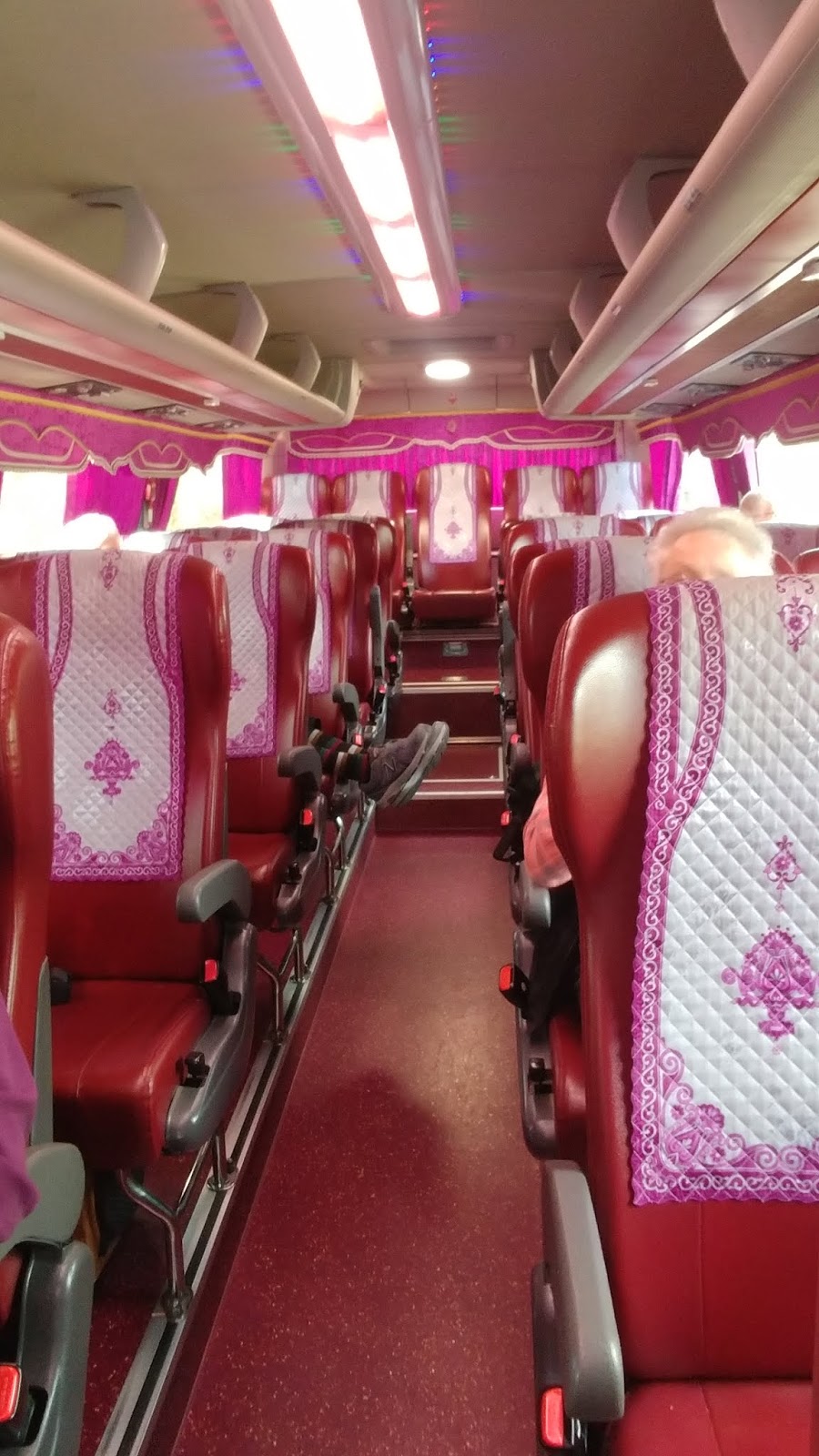
David has become our unofficial water bottle opener on the bordello bus for those too weak or arthritic to open their own.

Jinny’s English is still a mystery.

We still haven’t had Korean food. I don’t count the chicken soup. Lunch was at a buffet where selections ranged from sushi to pizza. We ate so much at lunch that our evening stroll through a nearby neighborhood past numerous eateries netted us no dinner, especially not the live baby octopus stew.

S. Korea has a low crime rate. Their youth are too busy studying for college eligibility. There’s no time for drugs or mischief.

We have everyone engaged in a quest for a hippo. Our now thirteen year old granddaughter is still collecting them. Hippopotamus is “Hama” in Korean. I even googled it and have the Korean spelling on my phone. Another couple is searching for peanut butter to make sandwiches in their room. They found jelly yesterday.

Tomorrow we lunch with Buddhist monks. Still no Korean food.

Toby
With Palace Guard

Wednesday, November 13, 2019

Seoul, S. Korea


October 19, 2019- Seoul, S. Korea


We lost a day of our lives traveling to Korea, but regain it coming home. Sorry we can’t give you any hints of the future. It just doesn’t work that way.


With the help of our little pal, Ambien, we slept through the night. It’s a no-brainer when we’ve flown to a time zone 13 hours different than ours.


Breakfast gave us the opportunity to learn how to use yet another coffee machine. I also learned that not every Caucasian in Korea speaks English. In an attempt to be helpful, I explained the mystery of the two spigots on the coffee maker only to get a polite smile and nod as he did what he pleased.


Most mornings start with a lecture. Today’s teacher was a PhD candidate from Michigan. She became interested in the language then the culture in middle school when she couldn’t understand her friends who were Korean twin sisters. As a paranoid middle-schooler, she thought they were talking about her when they lapsed into Korean.


Korea is flanked on three sides by the sea and is 70% mountains. Their dynasties were more stable than Japan’s or China’s so geographical pockets of culture developed and thrived for centuries. Japan colonized the peninsula from 1910-1945, and only left after WWII. Enter the USA and Russia in 1950, creating what was supposed to be a temporary division between north and south. When unification was tried in 1948, war broke out. Cessation of the war brought an authoritarian government to the south where rebuilding became a reality. The late 80’s to early 90’s saw the advent of open elections and democracy.


Shamanism is the only religion native to Korea. It is rarely practiced, although people may weave some of its rituals and beliefs into contemporary religions. Confucianism arrived in the first century BCE, while Buddhism came in the fourth century. Christianity made its way here by way of Jesuits from China. Koreans were quite opposed to a religion that conflicted so radically with Confucianism, especially regarding ancestor worship. They either drove the Jesuits out or killed them. In the nineteenth century, Protestants were more kindly welcomed since they brought western education and medicine with them. Today Christianity is the most widely practiced religion in S. Korea.


After the lecture, we boarded what I refer to as our bordello bus, passed a Krispy Kreme, and headed for the National Museum. Exhibits ranged from Paleolithic to celadon ceramic ware. It was a lovely building, but our guide, Jinny, herded us through at a fast pace. 


Speaking of Jinny, her accent is wearing on the group. People are starting to zone out because we can’t understand her and some are getting irritable. Korean words frequently have optional suffixes. She attaches that to English words along with the common replacement of the “L” for “R.” For example, it took a bit to realize that “loofehs ” were roofs. I couldn’t understand why Paris was so important until I guessed we were going to visit the Palace. When explaining about kings and concubines, she frequently mentioned that the king was impotent. That confused me as to how the dynasties were sustained. In reality, the group consensus was that the kings were all “important.” Sometimes her answers to questions fall short or are misleading due to language. David asked if there was a lot of walking at the Palace. She said that we were taking the bus. David didn’t take his hiking poles. There was tons of walking on uneven surfaces and steps with no railing. She must have thought he asked if we were walking “to” the Palace. Some responses are funny like when she told us we could recognize our hotel by the blue bow. We were all confused until she pointed to a blue statue of a man bowing. Aside from being hard to understand, she seems set in her ways. Several people asked about an ATM to change money. Jinny was vague at best and preferred what sounded like currency exchanges. Her concern turned out to be the service charge we’d have to pay at the machine. There was actually an ATM in our hotel. No one cared about the fee. 


In the end, the Palace, a UNESCO site, looked like a smaller version of the Forbidden City in China only lots cleaner. In fact, judging by Seoul, Korea is very clean and pretty much litter free. The Secret Garden of the Palace consisted of sand paths, pagodas, greenery, and no flowers.  Color was provided by local tourists who rented traditional Korean costumes and re-enactors. Because Koreans built with wood and heated with wood or charcoal burners under the floors, most historic buildings aren’t original. Duh, wooden buildings burn.


Lunch was billed as an authentic cultural experience. We had a reservation, but people were lined up to eat the famous chicken soup.  Whole disemboweled chicken stuffed with rice is cooked in and served in a clay pot. The result was disappointing. It was tasteless, the rice had become pasty, and the poor bird was more bones than meat. I think we all left hungry. 


Most people were too tired for dinner, but we got together with Audrey from Manhattan, and, with Jinny, we walked a few blocks to a happening street market where we had dinner on the hoof. Jinny escorted us there, cautioned us not to eat meat, and turned us loose. She does want to be helpful. I loved the egg bread. It’s a thick sweet slice of baguette with a fried egg on top. The red bean pancake was yum. David wasn’t happy with his kim chee omelet but liked his cup of sweetened potatoes. There was a variety of fish, eel, and shellfish offerings along with dumplings. I laughed at the Oreo churros and cringed at the seaweed stuffed with Choices of Velveeta or Spam. I kid you not. We were lured to a cart by two men singing a jingle in English as they stretched a honey and flour mixture into paper thin strands, filled it with chopped chocolate, and rolled it into candy. I admit that I initially thought they were singing “lowly,lowly,lowly” until I watched what they were doing and realized they were saying “rolly, rolly .” 


We found the blue bow and our hotel in time to get to bed on the early side. Tomorrow we continue touring Seoul.


Toby


Bordello Bus

Costumed Women at Palace

Food Trucks


Arriving in Seoul, S. Korea


 Oct. 17,  2019


We’re off on another adventure halfway around the world. South Korea is our destination. We arrived a few hours ago, ate a bite, and went to an orientation meeting with our heavily accented guide Jinny. There are only ten on this our second Road Scholar trip, three couples and four singles. The oldest is 81, and I guess the young couple is in their 50’s. Other than the two hour drive in from Inchon Airport, we’ve seen modern skyscrapers and a cart full of oranges. Neighborhoods seem to flow from metropolitan to quaint niches of color and culture. The Japanese occupation must have left them with an affinity for complex toilets. We half expected them in our hotel rooms, but having them in the stalls of airport restrooms was novel.


As with all our adventures, we seem to create or fall into unusual circumstances. First thing this morning, after our 25-minute flight from Akron to Detroit, David mistakenly used the ladies room. He has a new travel outfit with sweatpants and no fly and had to use a stall. I don’t think he realized his mistake until he was finished. He left the ladies room quickly and decided to wash his hands in the men’s room. 


For some reason flights to South Korea have additional security checks. Passengers go through a facial scan at the gate, then ICE is waiting at the end of the jetway for further inspections. Today they removed an Asian family of four.


We flew premium economy which meant we boarded after first class and before economy, had extra legroom, wider seats, white dish towels thrown over our tray tables, ceramic dishes, and stainless cutlery.    


Most of you have received these emails while we travel. You know that sometimes they are opinionated, informational, or free association. I tend to include information about meals since there are several readers who enjoy culinary details. Reactions are welcome to any of my opinions.


Unfortunately, I have to dictate the material or use the iPads built in keyboard now. My external keyboard is malfunctioning. I hope to get It figured out, but three young Korean women have failed. Perhaps a good charge will help. It seems to have dead spots.


Tomorrow we’ll tour old and new Seoul. The DMZ is closed indefinitely. It isn’t due to political bickering. This time it’s because of an invasion of the African swine flu brought in from China by way of N. Korea.


Toby